
English Worksheets
English worksheets for kids include engaging printable activities designed to improve reading, writing, vocabulary, phonics, and grammar skills. These fun and educational worksheets help children build a strong foundation in English through interactive exercises and practice activities. Perfect for preschool, kindergarten, and primary school students, these printable worksheets make learning English easy, enjoyable, and effective for both teachers and parents.


Worksheets
Found 23 worksheet(s)
Action Words Verbs Worksheet for Grade 1 | Learn Verbs
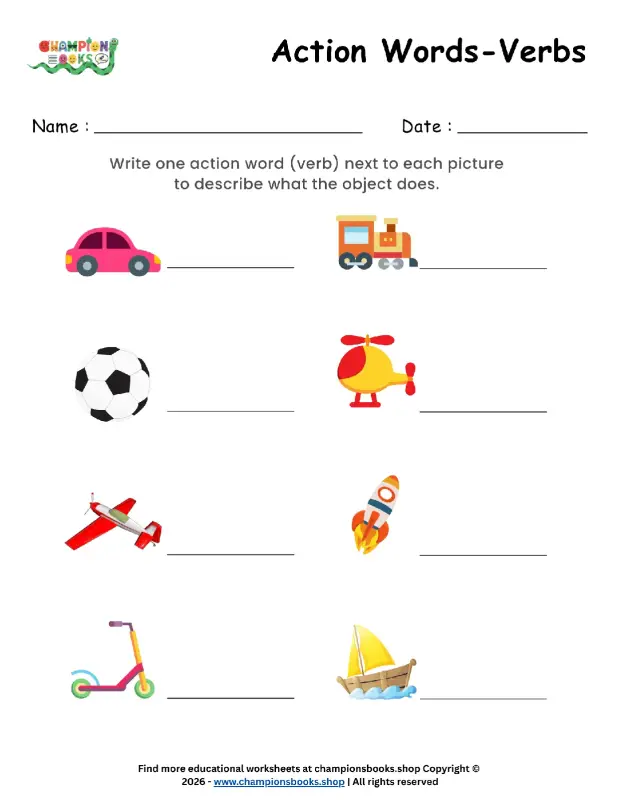
About this Worksheet This engaging worksheet is specifically crafted to help Grade 1 students master action words, also known as verbs. Each section presents a clear, colorful illustration of a familiar object – from a zooming car and a chugging train to a soaring airplane and a floating sailboat. Children are prompted to write a single action word (verb) next to each picture that accurately describes what the object typically does. This direct and interactive approach makes learning about verbs accessible and enjoyable for young learners, transforming abstract grammatical concepts into concrete, relatable actions. It’s an ideal resource for introducing foundational grammar in a visually stimulating and easy-to-understand format. Learning Benefits Incorporating this action words worksheet into a learning routine offers numerous educational advantages for young students: Enhanced Verb Recognition: Directly helps students identify, understand, and differentiate verbs as words that describe actions. Vocabulary Enrichment: Encourages children to think of and use a wider range of descriptive action words, thereby expanding their active vocabulary. Foundational Sentence Building: Lays essential groundwork for constructing grammatically correct sentences by understanding the pivotal role verbs play. Core Grammar Skills Development: Strengthens fundamental English Language Arts (ELA) skills, which are crucial for literacy development and future academic success. Visual Learning Engagement: Appeals strongly to visual learners through its use of bright, relatable images, making the abstract concept of verbs more concrete and memorable. Critical Thinking: Promotes observation and critical thinking as students analyze each object and determine its primary action. How to Use This versatile worksheet can be effectively utilized in a variety of educational settings. Educators can integrate it as a dynamic classroom activity, a quick formative assessment to gauge understanding, or a practical homework assignment to reinforce learning. For parents, it serves as an excellent tool for at-home learning, supplementing school lessons, or providing extra practice during breaks. Encourage children to brainstorm multiple actions each object could perform before settling on the most appropriate verb. This approach not only solidifies grammatical understanding but also sparks creativity and imaginative thinking. It's an invaluable resource for any Grade 1 curriculum focusing on parts of speech, sentence structure, and early literacy.
Master Active & Passive Voice: Grade 7 English Worksheet
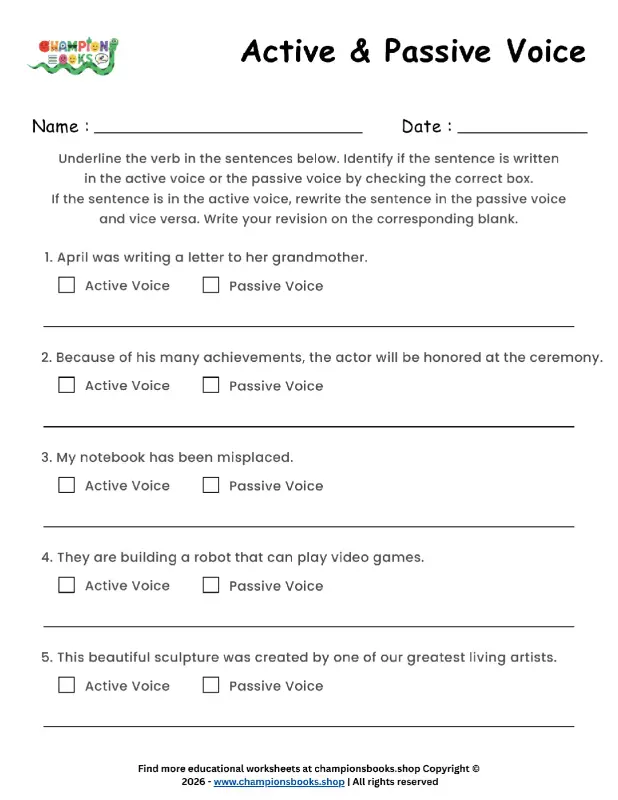
About this Worksheet Dive deep into the world of sentence structure with our comprehensive Active and Passive Voice worksheet, perfectly tailored for Grade 7 students. This engaging printable challenges learners to master a fundamental aspect of English grammar. Each task is designed to build confidence and understanding: Underline the Verb: Students begin by identifying and underlining the key action word in each sentence. Identify the Voice: They then determine whether the sentence is written in the active or passive voice by checking the appropriate box. Rewrite Sentences: The critical final step involves transforming the sentence. If it's active, rewrite it in the passive voice, and if it's passive, convert it to active voice. This hands-on practice solidifies comprehension and application. With five carefully crafted sentences, this worksheet offers targeted practice that reinforces learning and encourages students to think critically about how sentences are constructed and how meaning can shift based on voice. Learning Benefits Utilizing this active and passive voice worksheet offers numerous educational advantages: Develops Advanced Grammar Proficiency: Students will gain a profound understanding of active and passive voice, a crucial skill for sophisticated writing. Enhances Sentence Structure & Clarity: The practice of rewriting sentences significantly improves their ability to construct clear, concise, and impactful sentences. Boosts Overall Writing Quality: Mastering when and how to appropriately use each voice empowers students to make deliberate stylistic choices in their writing, leading to more effective communication. Sharpens Critical Thinking Skills: Analyzing sentences to determine their voice and then reformulating them hones analytical and problem-solving abilities. Prepares for Higher-Level English: A strong grasp of voice is foundational for advanced literary analysis, academic writing, and standardized tests. Versatile Use: Ideal for in-class activities, homework assignments, or supplementary practice for students needing extra support or enrichment in English Language Arts (ELA). This resource supports independent learning for Grade 7 students aiming to excel in grammar.
Fun Adjectives Worksheet for Grade 1 | Describe Pictures!
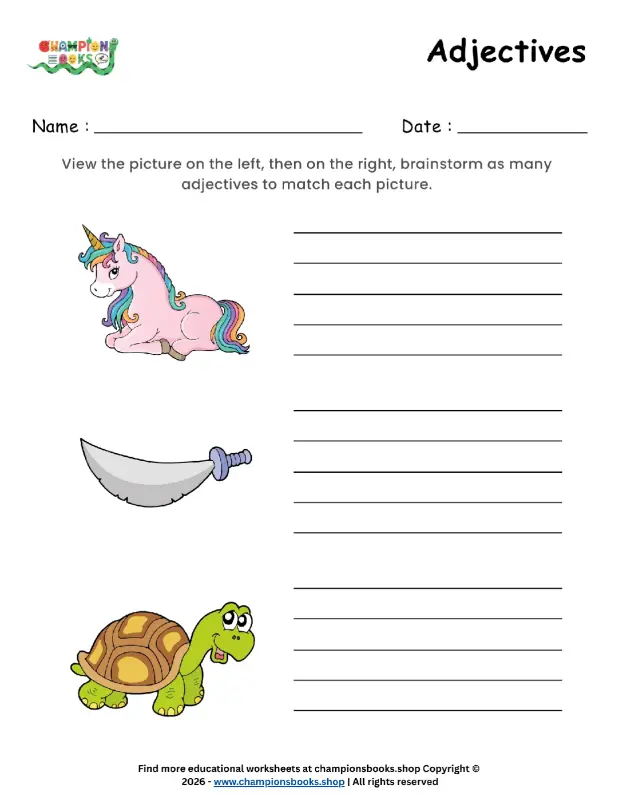
About this Worksheet This engaging Grade 1 Adjectives Worksheet is designed to help young learners master the art of descriptive language. Students are presented with three distinct images: a magical unicorn, a formidable sword, and a friendly turtle. The task is to carefully observe each picture and then brainstorm as many adjectives as possible to describe them. This activity encourages children to think critically about the attributes of objects and expand their vocabulary in a fun, visual way. Learning Benefits Using this worksheet offers numerous educational advantages for first graders: Vocabulary Expansion: Introduces and reinforces a wide range of descriptive words. Grammar Skills: Solidifies understanding of adjectives as words that describe nouns. Observation Skills: Encourages close attention to detail in images to identify various characteristics. Creative Thinking: Promotes imaginative thought as students consider different ways to describe familiar and fantastical objects. Writing Readiness: Builds a strong foundation for more complex descriptive writing tasks in the future. Language Arts Practice: Provides targeted practice for a key component of English language arts curriculum. This worksheet is an excellent resource for teachers in the classroom, homeschooling parents, or anyone looking to give their child a head start in understanding adjectives and enriching their descriptive vocabulary. It's a simple yet effective tool for making grammar both accessible and enjoyable for Grade 1 students.
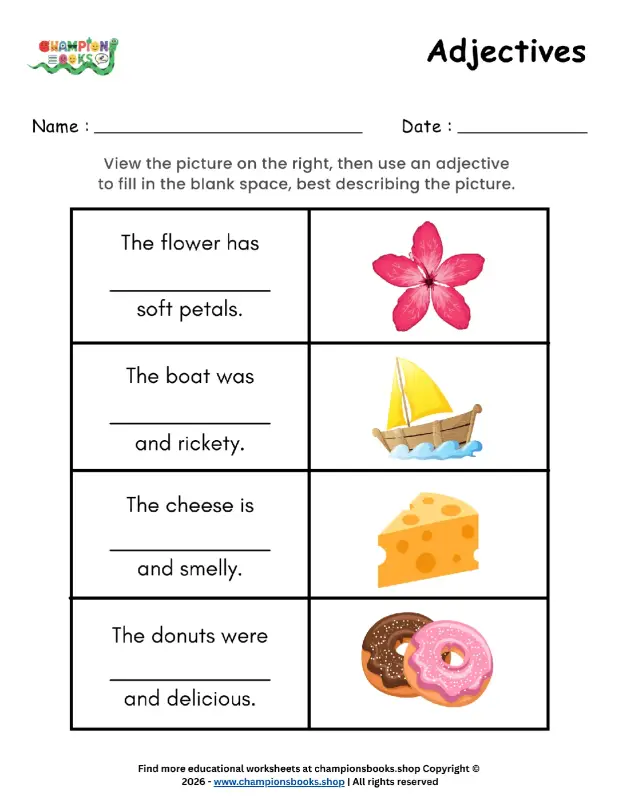
Adjectives Worksheet for Grade 2 - Describe & Learn!
Dive into the exciting world of descriptive words with our Adjectives Worksheet for Grade 2! This engaging printable is designed to help young learners identify and use adjectives effectively to describe nouns, enriching their language and writing abilities. About this Worksheet This interactive worksheet presents students with a series of vibrant pictures, including a beautiful flower, a sturdy boat, delicious cheese, and tempting donuts. For each image, there's a sentence with a blank space where students need to fill in an appropriate adjective. The goal is to choose the best descriptive word that accurately portrays the object in the picture, enhancing their understanding of how adjectives add detail and color to language. Picture-based learning: Visual cues aid comprehension and make the task more accessible. Fill-in-the-blank format: Encourages active recall and application of vocabulary. Real-world objects: Relatable examples make learning fun and relevant to everyday experiences. Clear instructions: Easy for students to understand and complete independently or with minimal guidance. Learning Benefits Using this adjectives worksheet offers numerous educational advantages for Grade 2 students: Vocabulary Expansion: Students discover and apply new descriptive words, broadening their lexicon. Grammar Reinforcement: Solidifies understanding of adjectives as essential parts of speech. Observation Skills: Encourages careful observation of details in images to select the most fitting adjective. Sentence Structure: Helps children construct more descriptive and interesting sentences in their writing. Language Arts Proficiency: Builds a strong foundation for future writing, reading comprehension, and overall communication skills. Perfect for classroom activities, homework assignments, or homeschooling, this Grade 2 adjectives worksheet is an excellent resource for developing essential language skills. Download and print today to make learning adjectives an enjoyable and effective experience!
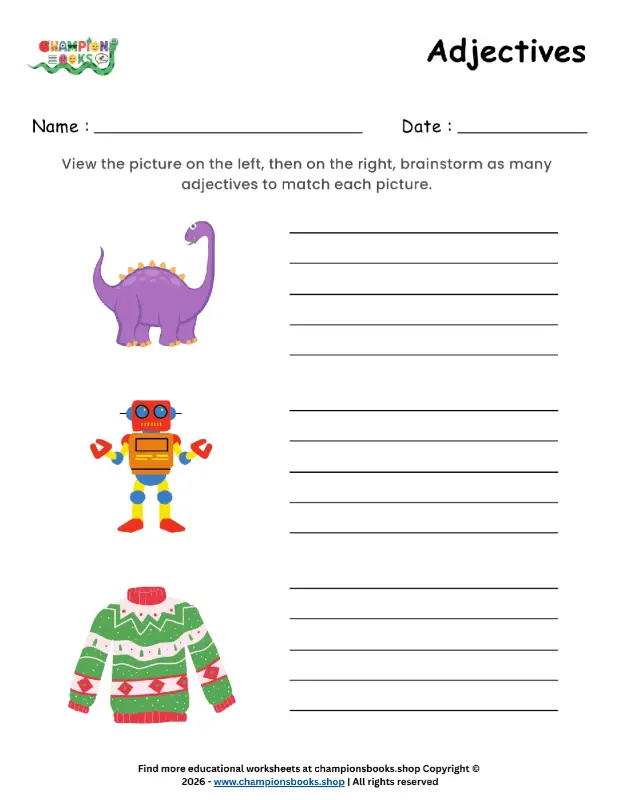
Adjectives Worksheet for Grade 1 | Describe Pictures Fun!
About this Adjectives Worksheet This engaging Adjectives Worksheet is designed for young learners in Grade 1 to strengthen their understanding and use of descriptive words. Students will be presented with three distinct images: a friendly purple dinosaur, a vibrant robot, and a cozy Christmas sweater. The task involves observing each picture carefully and then brainstorming as many adjectives as possible to describe them, writing them on the lines provided. Learning Benefits Using this worksheet offers numerous educational advantages for first graders: Enhances Vocabulary: Encourages students to think of a wide range of descriptive words to enrich their language. Develops Observational Skills: Promotes close attention to detail in images, fostering critical visual analysis. Strengthens Grammar Knowledge: Reinforces the concept of adjectives as words that describe nouns, improving grammatical understanding. Boosts Creative Thinking: Prompts imaginative thought in describing everyday objects, encouraging unique perspectives. Improves Writing Foundations: Lays the groundwork for more descriptive and engaging writing later on, making stories and reports more vivid. How to Use This Worksheet This printable Adjectives Worksheet is perfect for in-class activities, homework assignments, or supplementary practice at home. Teachers and parents can guide students to think about various aspects of each image, such as color, size, texture, and mood, to generate a rich list of adjectives. It's an excellent resource for introducing parts of speech in a fun and interactive way, helping children grasp the importance of using descriptive language to make their communication more vivid and precise. Encourage students to share their adjectives and discuss why each word fits the picture, promoting collaborative learning and deeper understanding.
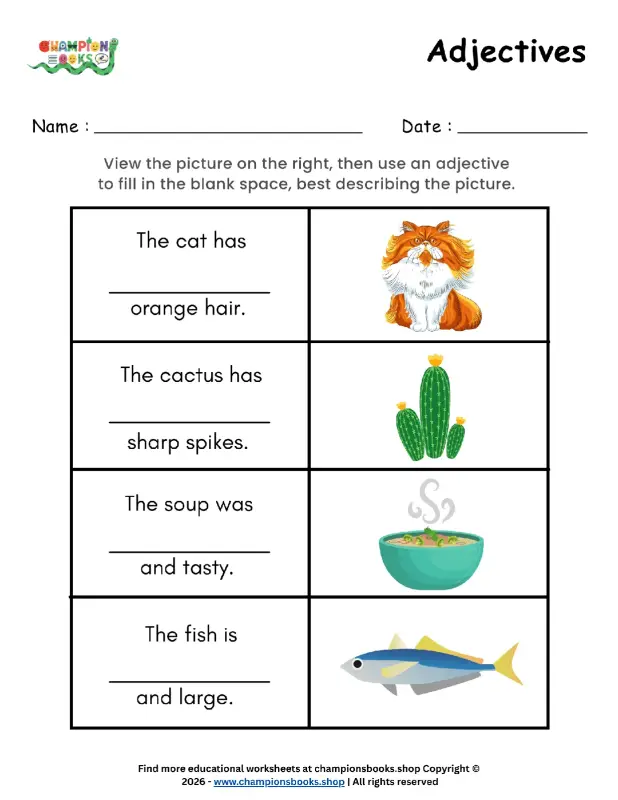
Adjectives Worksheet for Grade 1: Describe Pictures!
About this Adjectives Worksheet Engage your young learners with our vibrant Adjectives Worksheet designed specifically for Grade 1 students. This interactive activity helps children understand and identify descriptive words by connecting them to real-world objects and images. Each section presents a clear picture alongside a simple sentence with a blank space, prompting students to think of the best adjective to complete the description. For example, they'll describe a cat's "orange hair" or a cactus's "sharp spikes." This hands-on approach makes learning adjectives both fun and intuitive, reinforcing their understanding of how words modify nouns. Key Skills Developed This worksheet is an excellent resource for developing foundational language arts skills crucial for early elementary education. By completing this engaging activity, students will actively work on and improve the following competencies: Identifying Adjectives: Students will learn to recognize and select words that describe the qualities, characteristics, or states of nouns. Expanding Vocabulary: They will discover and apply new descriptive words, enriching their lexicon and improving their ability to express themselves. Improving Reading Comprehension: Understanding how adjectives add crucial detail and meaning to sentences, thereby enhancing overall text comprehension. Boosting Early Writing Skills: Developing the ability to use richer, more expressive language, which is a vital step towards crafting more engaging and detailed written work. Enhancing Observation Skills: Encouraging close attention to details in pictures to select the most fitting and accurate adjective, fostering critical thinking. Perfect for classroom use, homework assignments, or supplementary practice at home, this Grade 1 adjectives worksheet supports essential grammar learning in an accessible and visually appealing format. It's a fantastic tool to solidify understanding of parts of speech and build a strong foundation for future language development, ensuring students can effectively describe the world around them.
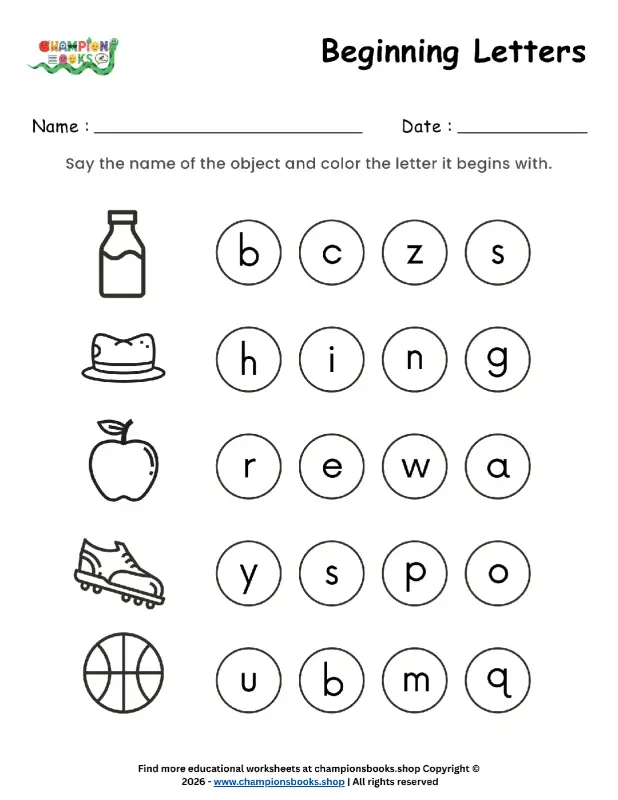
Kindergarten Beginning Letters Worksheet for Phonics
About this Beginning Letters Worksheet for Kindergarten Ignite your child's early literacy journey with our engaging Beginning Letters Worksheet, perfectly tailored for Kindergarten students. This vibrant printable activity is designed to help young learners master the crucial skill of identifying initial sounds in words. Featuring a clear layout, each section presents a familiar object – from a milk bottle and a hat to an apple, skateboard, and basketball – alongside a choice of four lowercase letters. The exciting challenge for children is to say the name of the object aloud, listen carefully for its starting sound, and then color the corresponding letter. This interactive approach transforms phonics practice into a fun, visual, and auditory experience. It helps solidify the connection between spoken language and written letters, building a strong foundation for reading and spelling. Whether used in a classroom setting, for homeschooling, or as supplementary practice, this worksheet is an invaluable tool for early phonics development. Key Learning Benefits & Skills Developed Initial Sound Identification: Children learn to isolate and recognize the first sound in a variety of common words. Letter Recognition: Reinforces the visual identification of lowercase letters and their associated sounds. Phonological Awareness: Develops essential pre-reading skills by focusing on the sound structure of words. Vocabulary Building: Expands and reinforces the recognition of everyday objects. Fine Motor Skills: The act of coloring helps improve hand-eye coordination, pencil control, and dexterity. Problem-Solving: Encourages critical thinking as children choose the correct letter from a set of options. Why Choose Our Kindergarten Beginning Letters Worksheet? Our Beginning Letters Worksheet stands out as an excellent educational resource for both teachers and parents. It offers a straightforward, child-friendly design that keeps learners engaged while they acquire fundamental phonics skills. By providing clear instructions and relatable images, it ensures that children can work independently or with minimal guidance. Prepare your little one for reading success by incorporating this effective and enjoyable initial sounds practice into their learning routine today!
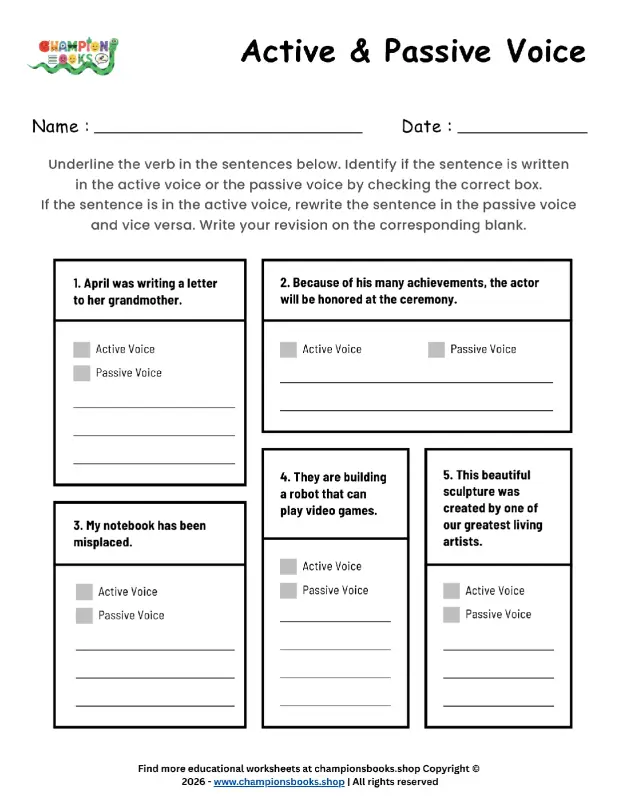
Master Active & Passive Voice: Grade 6 Grammar Worksheet
Unlock the power of effective writing with our comprehensive Active & Passive Voice worksheet, specifically designed for Grade 6 students. This engaging printable helps young learners distinguish between active and passive voice, a crucial skill for clear and concise communication. About this Worksheet This worksheet presents five unique sentences, each offering an opportunity to deepen understanding of voice in grammar. Students are tasked with: Underlining the verb in each sentence. Identifying whether the sentence is in active voice or passive voice by checking the appropriate box. Rewriting the sentence to change its voice (from active to passive, or passive to active) on the provided lines. This hands-on approach encourages critical thinking and reinforces the rules of verb conjugation and sentence construction. Learning Benefits Utilizing this active and passive voice worksheet offers numerous educational advantages: Enhanced Grammar Skills: Students will solidify their understanding of active and passive voice. Improved Sentence Structure: Practice in rewriting sentences helps develop flexibility and precision in writing. Critical Analysis: Learners will sharpen their ability to analyze sentence components, particularly verbs and subjects. Writing Clarity: Understanding when to use active versus passive voice leads to more impactful and direct writing. Preparation for Advanced English: Mastering this concept provides a strong foundation for more complex grammatical studies. Perfect for classroom activities, homework assignments, or supplementary practice at home, this Grade 6 active and passive voice worksheet is an invaluable resource for any language arts curriculum.
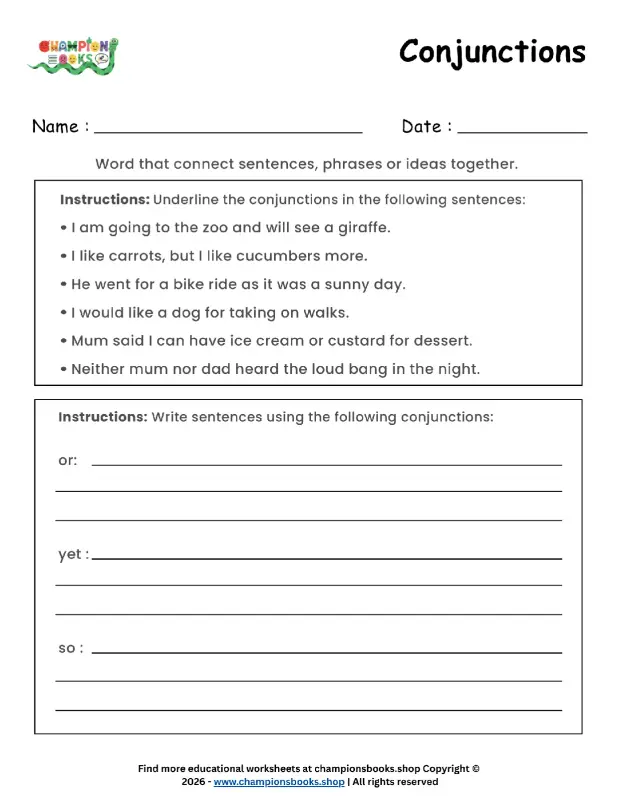
Master Conjunctions: Grade 3 Grammar Worksheet & Practice
About this Conjunctions Worksheet Enhance your child's grammar skills with this engaging Grade 3 Conjunctions Worksheet. Designed to help young learners understand and effectively use connecting words, this worksheet provides targeted practice for fundamental English language arts concepts. Conjunctions are vital for building complex sentences and expressing ideas clearly, making this a crucial step in language development. What Students Will Learn This worksheet focuses on two key aspects of mastering conjunctions: Identifying Conjunctions: Students will read a series of sentences and underline the conjunctions such as 'and', 'but', 'or', 'so', 'yet', and 'nor'. This exercise helps them recognize these essential connecting words in context. Using Conjunctions in Sentences: The second part challenges students to write their own sentences using specific conjunctions like 'or', 'yet', and 'so'. This encourages creative thinking and practical application of grammatical rules. Learning Benefits Regular practice with worksheets like this offers numerous educational advantages: Improved Sentence Structure: Students learn how to connect clauses and phrases smoothly, leading to more coherent and sophisticated writing. Enhanced Reading Comprehension: Understanding how conjunctions link ideas helps children better grasp the meaning of complex texts. Vocabulary Expansion: Exposure to varied sentence constructions indirectly boosts vocabulary and language fluency. Grammar Foundation: Builds a strong understanding of parts of speech, which is essential for future language learning. Perfect for classroom activities, homework assignments, or supplementary home learning, this worksheet is an excellent resource for solidifying Grade 3 conjunctions knowledge.
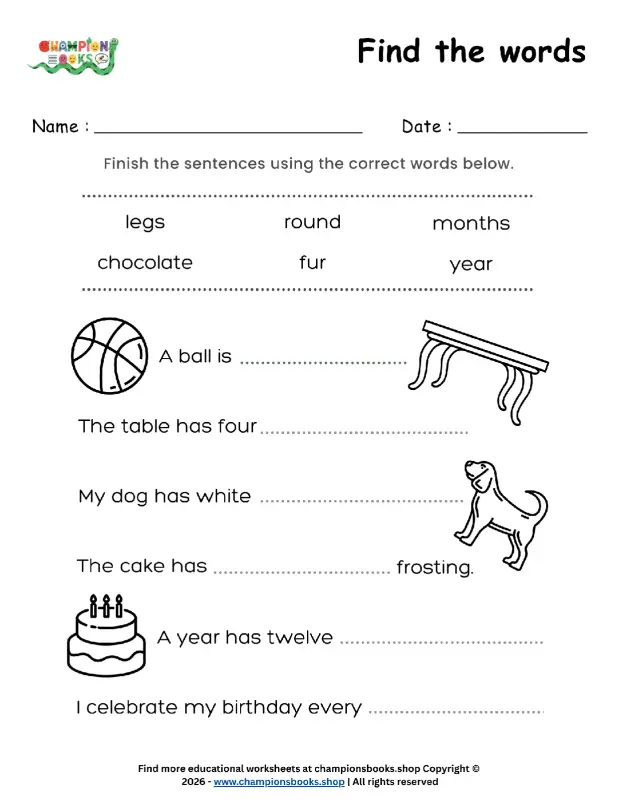
Find the Words Worksheet for Grade 1 | Sentence Completion
About This Find the Words Worksheet This engaging Find the Words worksheet is designed specifically for Grade 1 students to enhance their vocabulary and reading comprehension skills. Learners are presented with six simple sentences, each containing a blank space. A helpful word bank at the top of the page provides six key words: legs, round, months, chocolate, fur, year. Students must read each sentence and choose the most appropriate word from the bank to complete it accurately. This activity encourages critical thinking and strengthens the connection between words and their meanings within context. Learning Benefits for Grade 1 Vocabulary Expansion: Introduces and reinforces common nouns and adjectives. Reading Comprehension: Students must understand the meaning of the sentence to select the correct word. Sentence Structure: Helps children understand how words fit together to form complete and meaningful sentences. Critical Thinking: Encourages students to analyze options and make logical choices. Word Recognition: Improves sight word recognition and decoding skills. How to Use This Worksheet This worksheet is ideal for classroom use, homework assignments, or supplementary learning at home. Teachers can use it as a quick assessment of vocabulary and reading skills, or as a warm-up activity. Parents can utilize it to support their child's literacy development. Encourage students to read each sentence aloud before choosing a word, and then re-read the completed sentence to ensure it makes sense. This sentence completion activity is a fantastic tool for building foundational English language arts skills in young learners.
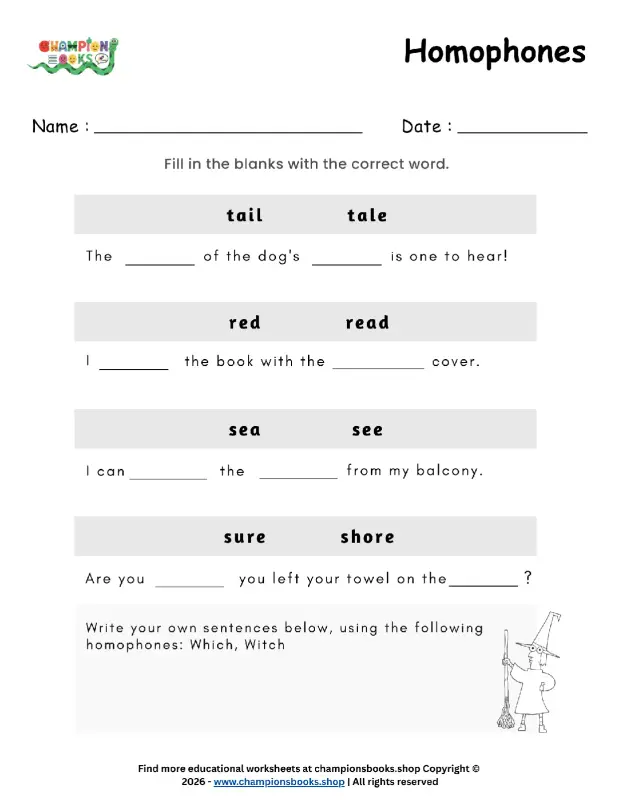
Master Homophones: Fun Fill-in-the-Blanks Worksheet for Kids
Dive into the fascinating world of words with our engaging Homophones Worksheet, specifically designed for Grade 2 learners! This printable activity helps young students master the art of distinguishing between words that sound alike but have different meanings and spellings. Understanding homophones is a crucial step in developing strong language arts skills, improving both reading comprehension and writing accuracy. About this Worksheet This comprehensive worksheet features two main sections to ensure a thorough understanding of homophones. The first part presents a series of interactive fill-in-the-blanks exercises. Students will choose the correct homophone from pairs such as "tail/tale," "red/read," "sea/see," and "sure/shore" to complete sentences accurately. This section encourages careful reading and contextual understanding. The second part challenges students to unleash their creativity by writing their own sentences using the homophone pair "which" and "witch." This advanced task not only reinforces their knowledge of these specific words but also hones their sentence construction and creative writing abilities. A fun illustration of a witch adds a playful touch to the activity. Learning Benefits Boosts Vocabulary: Introduces and reinforces commonly confused words. Enhances Spelling: Teaches correct spelling for sound-alike words. Improves Reading Comprehension: Helps students understand how context dictates word meaning. Develops Critical Thinking: Encourages students to analyze sentences and choose the most appropriate word. Fosters Creative Writing: The sentence-writing task promotes original thought and expression. Strengthens Grammar Skills: Reinforces the proper use of words in sentences. Perfect for classroom activities, homework assignments, or supplementary practice at home, this Grade 2 Homophones Worksheet is an invaluable resource for building foundational language skills. Download and print today to give your child a head start in mastering English vocabulary!
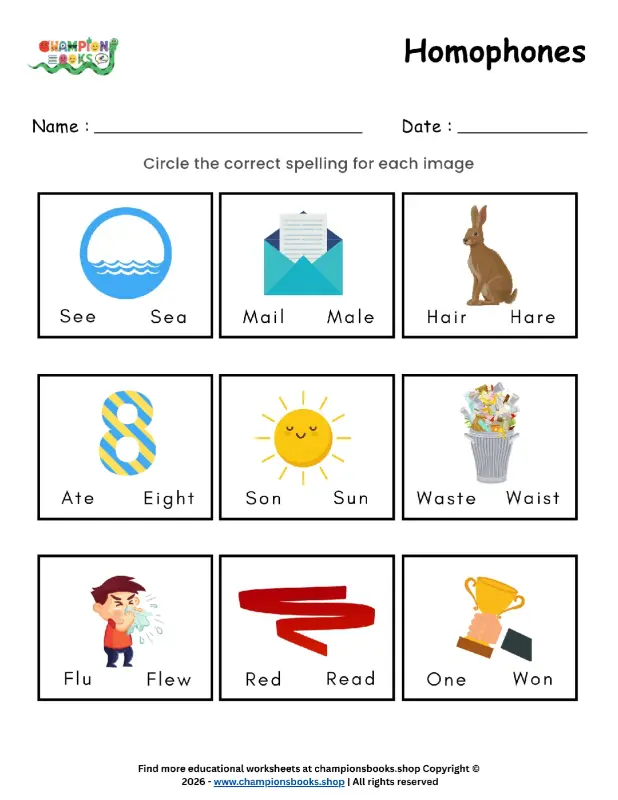
Homophones Worksheet for Grade 1: Learn Confusing Words
Introduce your Grade 1 student to the fascinating world of homophones with this engaging and educational worksheet! Designed to help young learners differentiate between words that sound alike but have different meanings and spellings, this printable activity is perfect for enhancing early literacy skills. About this Worksheet This vibrant worksheet presents nine sets of common homophones, each paired with a clear, illustrative image. Students are tasked with carefully examining the picture and then circling the correct spelling from the two options provided. For instance, they will choose between "Sea" and "See" for a picture of the ocean, or "Mail" and "Male" for an envelope. Other fun examples include "Hair" vs. "Hare", "Ate" vs. "Eight", and "Son" vs. "Sun", along with "Waste" vs. "Waist", "Flu" vs. "Flew", "Red" vs. "Read", and "One" vs. "Won". This visual and interactive approach makes learning complex linguistic concepts accessible and enjoyable for first graders. Learning Benefits Vocabulary Expansion: Students learn new words and their correct usage. Spelling Accuracy: Reinforces correct spelling for commonly confused words. Phonological Awareness: Develops an understanding of how sounds relate to different spellings. Reading Comprehension: Improves the ability to understand context clues. Critical Thinking: Encourages students to think carefully about word meanings and visual cues. Early English Language Arts: A foundational activity for mastering tricky aspects of the English language. Download this homophones worksheet today to provide a valuable learning experience that supports your child's journey in becoming a confident reader and writer!
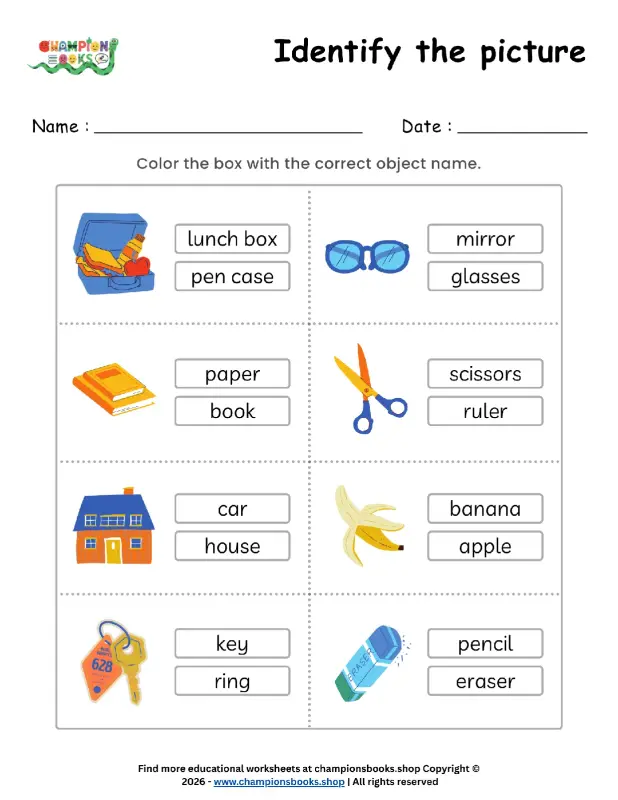
Identify the Picture Worksheet for Kindergarten | Fun Learning
This engaging "Identify the Picture" worksheet is perfectly designed for young learners in Kindergarten, providing a fantastic opportunity to enhance their observational skills and vocabulary. Children are presented with various common objects and tasked with identifying them by coloring the box next to the correct name. It's a simple yet effective activity that reinforces early literacy and object recognition. About this Worksheet Our "Identify the Picture" worksheet features a delightful array of everyday items that children will recognize. From a lunch box to glasses, a book, and even a banana, each item is clearly illustrated. The objective is for students to carefully look at each picture and then choose the correct word from two options provided, coloring the box corresponding to the right object name. This interactive approach makes learning enjoyable and memorable. Learning Benefits This worksheet offers numerous educational advantages for Kindergarten students: Vocabulary Expansion: Introduces and reinforces the names of common objects. Object Recognition: Develops the ability to visually identify and differentiate between various items. Early Literacy Skills: Helps connect written words with their corresponding images. Fine Motor Skills: Coloring the correct box aids in developing hand-eye coordination and pencil control. Critical Thinking: Encourages children to analyze and make choices based on visual cues and word recognition. Language Development: Supports understanding and using descriptive language. Engaging Activities for Home & Classroom Beyond simply completing the worksheet, extend the learning with these ideas: Flashcard Fun: Turn the pictures into flashcards for quick review. "I Spy" Game: Play "I Spy" using objects from the worksheet around the room. Storytelling: Ask children to create a short story using several items from the worksheet. Object Hunt: Have students find the actual objects around the classroom or home. This worksheet is an excellent resource for parents, teachers, and homeschoolers looking for effective and fun ways to build foundational vocabulary and recognition skills in young children.
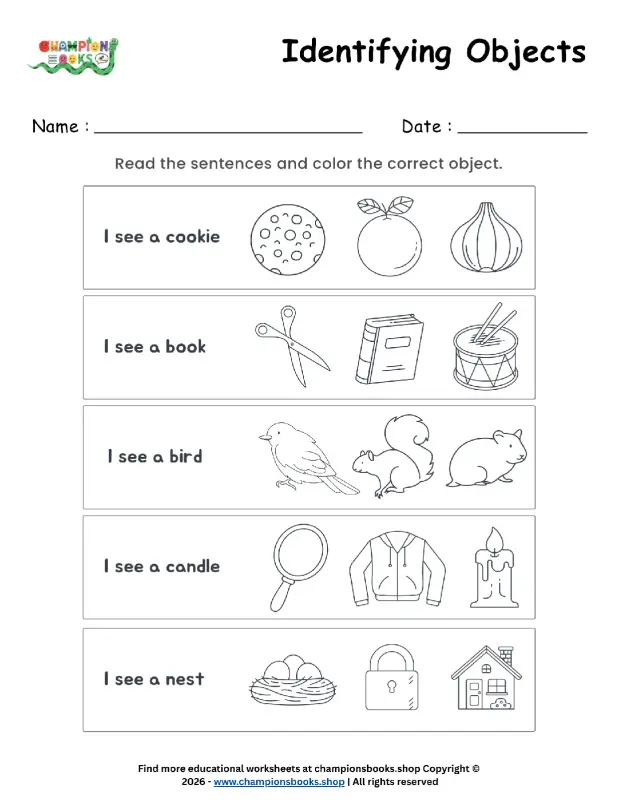
Kindergarten Identifying Objects Worksheet - Fun Learning
About this Kindergarten Identifying Objects Worksheet This engaging Kindergarten Identifying Objects Worksheet is designed to help young learners develop crucial early literacy and visual discrimination skills. Children will be presented with simple "I see a..." sentences, such as "I see a cookie" or "I see a book." For each sentence, they will find three distinct images. Their task is to carefully read the sentence and then identify and color the picture that accurately matches the text. This activity provides a fantastic blend of reading practice, vocabulary reinforcement, and creative expression through coloring. It’s a perfect resource for enhancing foundational learning in a fun, interactive way. Key Learning Benefits This valuable worksheet offers a range of educational advantages for developing minds: Object Identification: Strengthens the ability to recognize and correctly name a variety of common objects. Early Reading Comprehension: Fosters an understanding of basic sentence structures and the skill of matching written words to corresponding images. Vocabulary Expansion: Introduces and reinforces new words, building a stronger vocabulary foundation for future learning. Visual Discrimination: Sharpens the ability to differentiate between similar objects and focus on specific visual cues. Fine Motor Skills Development: The act of coloring helps improve hand-eye coordination, pencil control, and overall dexterity. Following Instructions: Encourages students to carefully read and adhere to given directions, an essential skill for academic success. Concentration and Focus: Promotes sustained attention as children work through each sentence and image set. Perfect for Young Learners Whether you're a teacher looking for a classroom activity, a homeschooling parent, or simply want to provide extra practice at home, this printable worksheet is an excellent choice. Encourage your child to read each sentence aloud, discuss the different objects shown, and then carefully choose and color the correct one. It's an effective and enjoyable tool for assessing and reinforcing early reading and object recognition progress in Kindergarten.
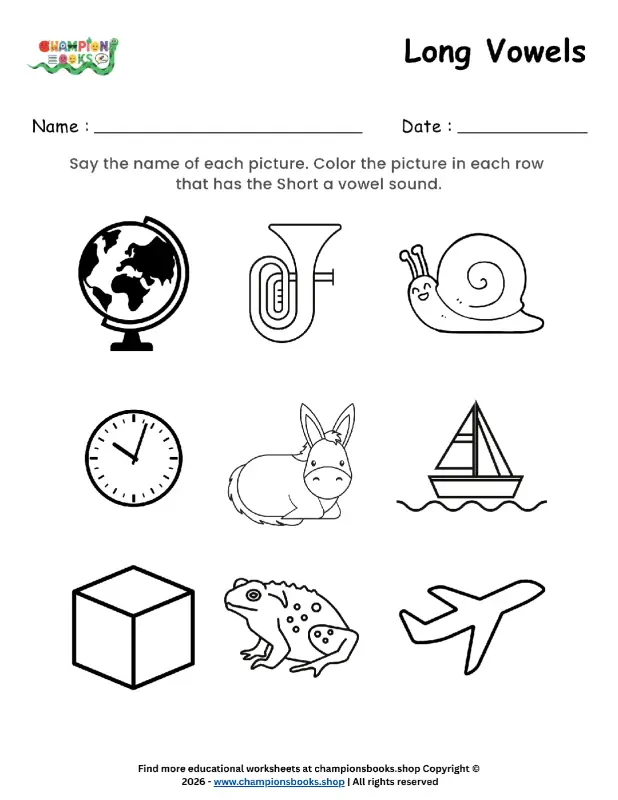
Long Vowels Worksheet for Grade 1 | Phonics Practice
About this Long Vowels Worksheet This engaging worksheet, titled 'Long Vowels,' is specifically designed to help first-grade students develop crucial phonics skills. The activity instructs students to 'Say the name of each picture. Color the picture in each row that has the Short a vowel sound.' While the worksheet's main title highlights 'Long Vowels,' this specific instruction can serve as a focused challenge for identifying a particular short vowel sound, or it can be used as a springboard for a broader discussion on various vowel sounds, both long and short. Students will encounter a variety of common objects such as a globe, snail, boat, and plane, providing excellent practice in identifying and differentiating between different vowel sounds. This visual and interactive approach makes learning phonics fun and memorable. Learning Benefits This worksheet offers multiple educational advantages for young learners: Phonological Awareness: Helps students distinguish between different vowel sounds, including long and short vowels. Vowel Recognition: Strengthens the ability to identify words containing specific vowel patterns. Vocabulary Building: Encourages students to name and associate sounds with common objects. Fine Motor Skills: The coloring activity enhances hand-eye coordination and fine motor development. Early Reading Skills: Builds a strong foundation for decoding and encoding words, essential for literacy development. Critical Thinking: Promotes analytical thinking as students evaluate sounds within words. How to Use This Worksheet Teachers and parents can effectively utilize this worksheet in several ways. Begin by having students clearly articulate the name of each picture. Then, guide them through the instruction: 'Color the picture in each row that has the Short a vowel sound.' This can lead to a valuable discussion about words that do and do not contain the 'Short a' sound. Alternatively, you can adapt the instruction to focus on identifying any long vowel sound, or specific long vowel sounds (e.g., long 'a' in 'snail'). This flexibility allows for targeted phonics practice tailored to your students' needs, reinforcing their understanding of vowel patterns in a fun and interactive way.
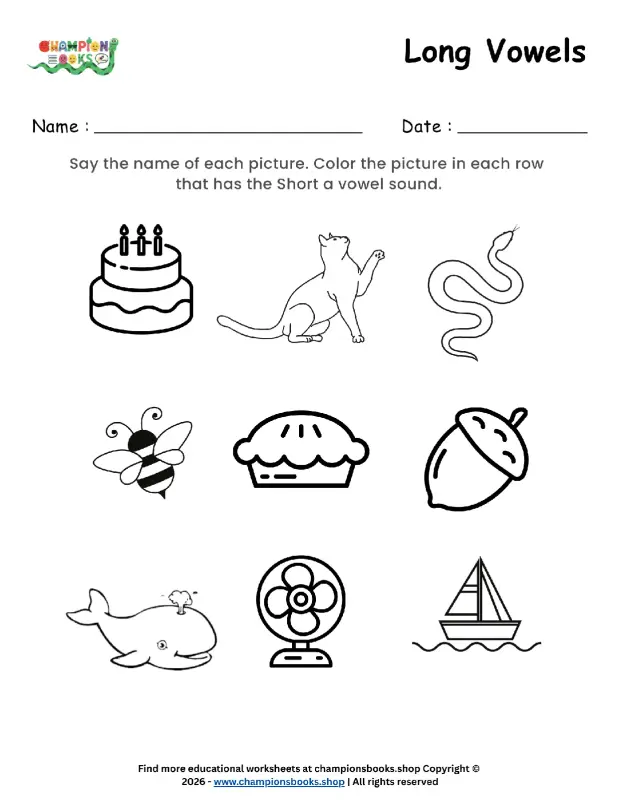
Short A Vowel Sound Worksheet for Kindergarten Phonics
Introduce your young learners to the foundational world of vowel sounds with this interactive Short A Vowel Sound Worksheet. Designed for Kindergarten and early elementary students, this phonics activity helps children distinguish between various vowel sounds, specifically focusing on identifying the short 'a' sound. About this Worksheet This worksheet presents three rows of engaging pictures. The task for students is to say the name of each picture aloud and then color the picture in each row that has the Short 'a' vowel sound. For example, in the first row, children will identify 'cat' as having the short 'a' sound, while 'cake' and 'snake' feature a long 'a'. The worksheet also includes pictures with other vowel sounds (like 'bee' and 'pie'), encouraging comprehensive sound differentiation. This hands-on approach reinforces early literacy skills in a fun and memorable way. Learning Benefits Phonological Awareness: Develops the ability to hear, identify, and manipulate individual sounds in spoken words. Short 'A' Vowel Recognition: Strengthens the specific skill of identifying and producing the short 'a' sound. Vowel Differentiation: Helps students distinguish short 'a' from other short and long vowel sounds. Vocabulary Expansion: Introduces and reinforces common words associated with the pictures. Fine Motor Skills: Coloring the correct pictures enhances hand-eye coordination and fine motor control. Early Reading Foundation: Builds crucial pre-reading skills essential for decoding and spelling. How to Use This Worksheet Encourage children to name each picture clearly. Guide them to listen carefully to the vowel sound in the middle of each word. Discuss which words have the 'aaaa' sound of short 'a'. This worksheet is perfect for classroom activities, homework, or supplemental learning at home. It's an excellent resource for reinforcing phonics lessons and preparing children for more complex reading tasks.
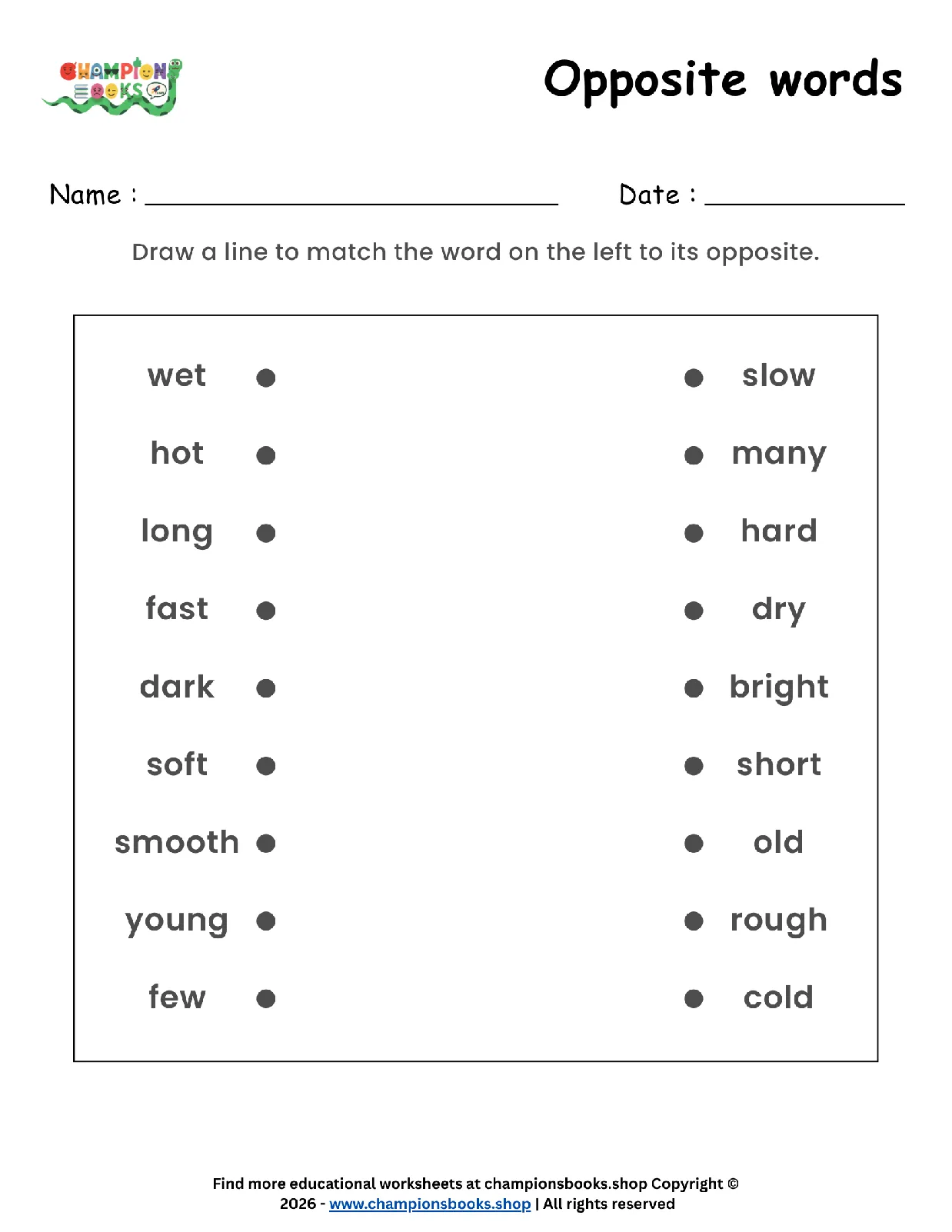
Opposite Words Worksheet for Grade 1 | Vocabulary Practice
This engaging worksheet is specifically designed to help young learners in Grade 1 master the concept of opposite words, a fundamental skill in early language development. By actively identifying and matching common antonyms, students will significantly strengthen their vocabulary and improve their understanding of word relationships. About this Worksheet This printable opposite words worksheet offers a clear and straightforward matching activity perfect for first graders. On the left side of the page, a list of nine common words is presented, each with a dot next to it. On the right side, the corresponding nine opposite words are listed in a scrambled order, also with dots. The primary task for students is to draw a line from each word on the left to its correct opposite on the right. The word pairs included are "wet" and "dry", "hot" and "cold", "long" and "short", "fast" and "slow", "dark" and "bright", "soft" and "hard", "smooth" and "rough", "young" and "old", and "few" and "many". This simple yet effective format ensures that students can focus on the vocabulary task without unnecessary distractions. Learning Benefits Engaging with this carefully crafted opposite words worksheet offers several key educational advantages for young learners: Vocabulary Expansion: Introduces and reinforces a core set of essential antonyms, broadening a child's word bank. Word Recognition and Comprehension: Improves the ability to identify and differentiate between words, enhancing overall reading comprehension. Critical Thinking Skills: Encourages students to analyze word meanings and understand the conceptual relationships between words. Language Arts Foundation: Builds a stronger foundation for more complex language arts concepts in subsequent grades. Fine Motor Skills Development: The act of drawing lines to match pairs helps in developing and refining hand-eye coordination and pencil control. Cognitive Processing: Supports the development of cognitive skills by requiring students to process information and make connections. Who is this for? This versatile worksheet is ideally suited for Grade 1 students who are actively learning about word relationships and expanding their vocabulary. It is also an excellent resource for early elementary learners, homeschooling parents, and classroom educators seeking a simple yet highly effective tool to teach and reinforce antonyms. It can be utilized for various educational settings, including in-class activities, assigned homework, or as a quick and engaging assessment to gauge understanding of opposite words.
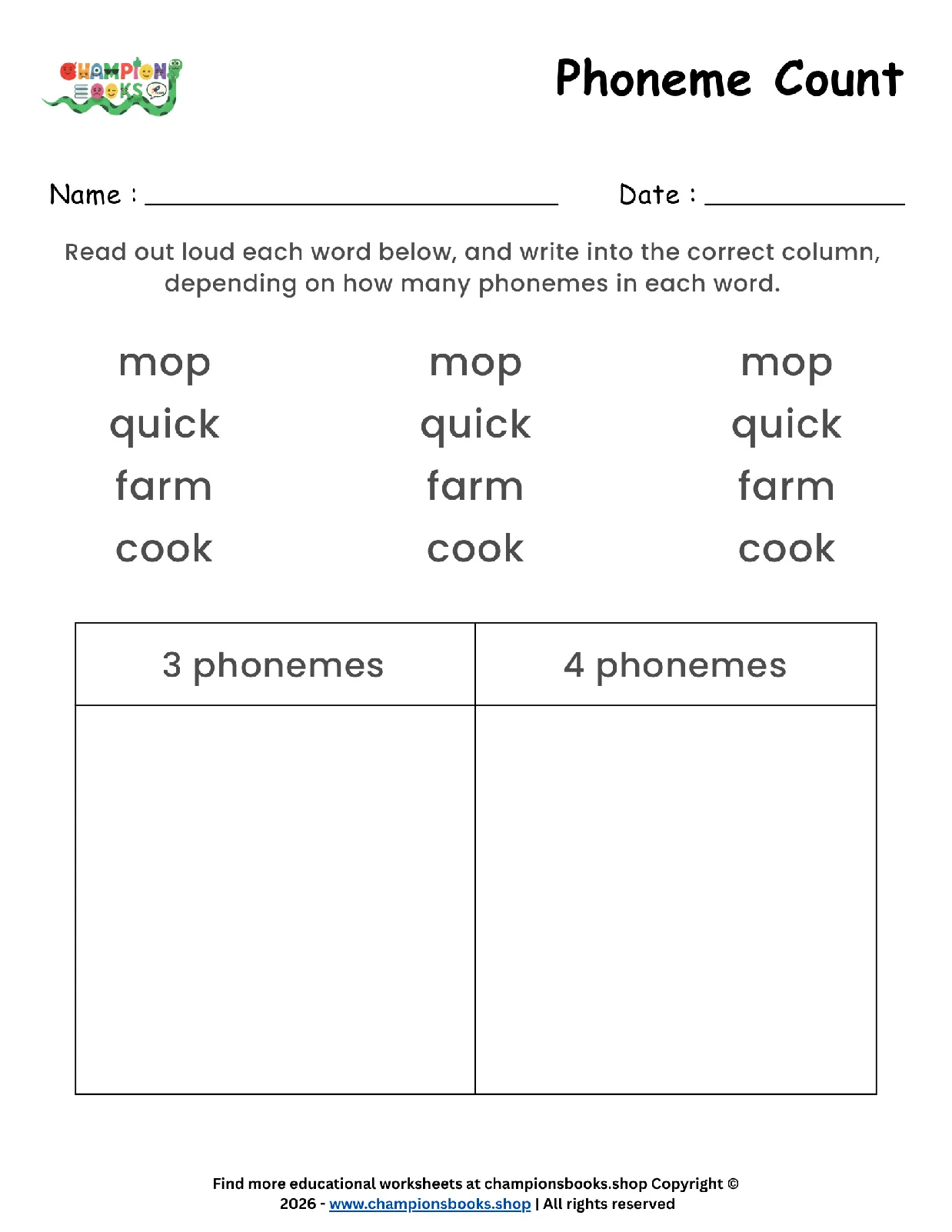
Phoneme Count Worksheet for Grade 1 | Learn Phonemes
About this Phoneme Count Worksheet This engaging Phoneme Count Worksheet is specifically designed for Grade 1 students to enhance their phonological awareness skills. It presents a clear and interactive activity where learners are tasked with reading a series of common words aloud. The core objective is to identify and count the individual phonemes (sounds) within each word, then correctly sort them into designated columns for words with 3 phonemes or 4 phonemes. Words like "mop," "quick," "farm," and "cook" provide excellent examples for practice, making the concept of sound segmentation tangible and accessible for young learners. Learning Benefits Utilizing this worksheet offers numerous educational advantages for developing readers: Strengthens Phonological Awareness: A foundational skill critical for reading and spelling success. Develops Sound Segmentation: Teaches children how to break down words into their constituent sounds, which is vital for decoding new words. Enhances Auditory Discrimination: Improves a child's ability to hear and distinguish individual sounds within spoken words. Supports Early Literacy: Builds essential pre-reading and reading readiness skills, paving the way for fluent reading. Boosts Word Recognition: By focusing on the sounds, students gain a deeper understanding of word structure. How to Use This Worksheet This printable worksheet is ideal for classroom use, homeschooling, or extra practice at home. Simply print it out and provide clear instructions to your Grade 1 student. Encourage them to say each word slowly and deliberately, listening carefully for every distinct sound. They can use their fingers to tap out each sound as they say it, a common strategy for phoneme segmentation. Once they have identified the number of phonemes, they should write the word into the correct column: "3 phonemes" or "4 phonemes." This activity can be done individually, in small groups, or as a whole-class exercise to foster discussion about word sounds.
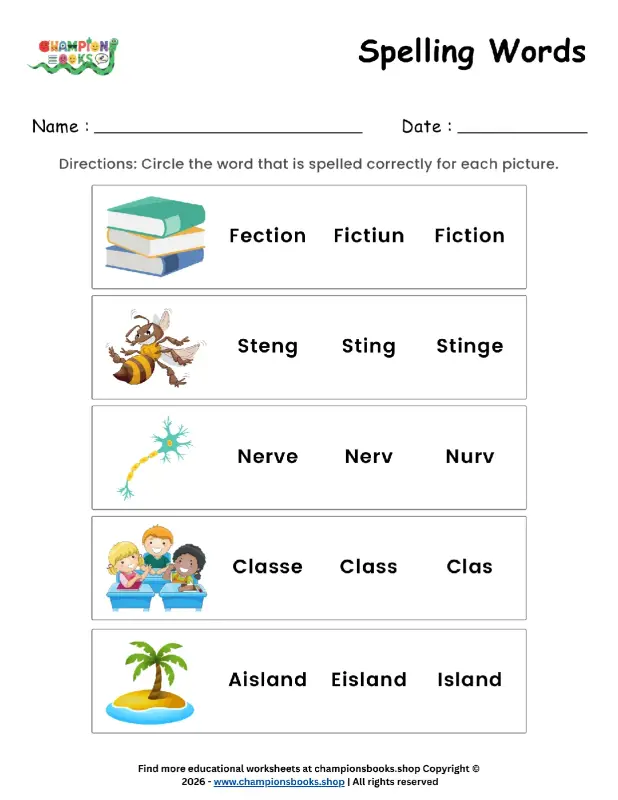
Grade 1 Correct Spelling Words Worksheet | Fun Practice
This engaging printable is designed to help young learners master essential spelling skills. Focusing on common words, this worksheet challenges students to identify and circle the correctly spelled word from a selection of choices, each accompanied by a clear picture. About this Worksheet Targeted for Grade 1 students, this worksheet provides focused practice in distinguishing between correctly and incorrectly spelled words. Each question features a vibrant image, such as books, a bee, a nerve cell, children in a classroom, and an island, to aid comprehension and engagement. Students will encounter words like 'fiction,' 'sting,' 'nerve,' 'class,' and 'island,' reinforcing their visual memory of correct spellings. The format encourages careful observation and critical thinking as learners select the right option from three similar-sounding or looking words. Learning Benefits Enhances Spelling Accuracy: Direct practice in identifying correct spellings improves retention and reduces common errors. Boosts Vocabulary: Introduces and reinforces common vocabulary words relevant to early elementary education. Develops Phonics Skills: Encourages students to sound out words and recognize correct letter patterns and phonetic structures. Improves Visual Word Recognition: Helps students quickly identify familiar words and their correct forms. Strengthens Critical Thinking: Requires students to analyze options and make informed choices based on their spelling knowledge. Perfect for: Classroom activities and independent work during spelling lessons. Homeschooling curriculum support for language arts. Extra practice for struggling spellers or early finishers. Reviewing foundational spelling concepts in a fun and interactive way. Download this valuable Grade 1 correct spelling worksheet today to provide your students with a fun and effective way to build their word mastery and confidence!
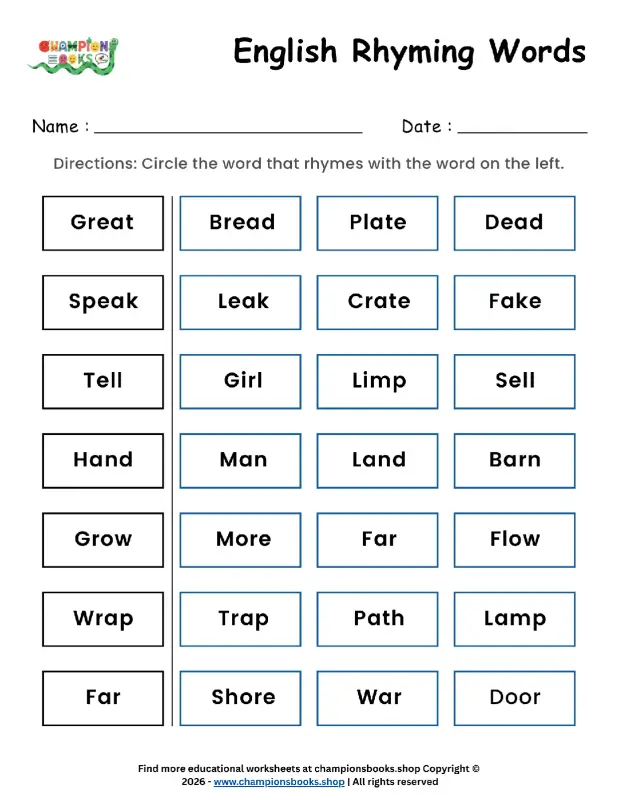
English Rhyming Words Worksheet for Grade 1 | Fun Practice
This engaging worksheet is specifically designed to help young learners in Grade 1 develop crucial rhyming word skills. Students are presented with a clear target word on the left and then challenged to identify and circle the rhyming word from a selection of three distinct options. This interactive activity is an excellent tool for building foundational literacy and enhancing phonological awareness, which are vital for early reading success. About this Worksheet Our "English Rhyming Words" worksheet provides a straightforward yet highly effective way for children to practice identifying words that sound alike. Each row features a prominent target word (e.g., "Great", "Speak", "Tell", "Hand") alongside three potential rhyming words, requiring careful auditory discrimination. The simple, clear instructions make it easy for students to understand the task, fostering independent learning and confidence. This printable resource is perfect for integration into classroom activities, assigning as homework, or utilizing for supplementary practice and reinforcement at home. It's designed to be visually appealing and easy to navigate for young minds. Learning Benefits Regular practice with this rhyming words worksheet offers several key educational advantages for developing readers: Significantly enhances phonological awareness, a critical pre-reading skill that involves recognizing and manipulating the sounds of language. Improves the recognition of common word families and consistent sound patterns within words. Builds a stronger foundation for both spelling accuracy and overall reading fluency. Expands vocabulary by encouraging students to actively listen to and think about word sounds and their relationships. Develops essential critical thinking and auditory discrimination skills as students carefully choose the correct rhyme from multiple choices. Boosts confidence in language arts as children successfully identify rhyming pairs. Who is this for? This worksheet is ideally suited for students in Grade 1 who are beginning to explore phonics and the intricate world of word sounds. It also serves as a fantastic review tool for slightly older students needing a refresher or as a challenging yet achievable activity for advanced Kindergarteners. Educators, homeschooling parents, and tutors seeking effective English language arts resources will find this printable highly beneficial for reinforcing the concept of rhyming words in an accessible and engaging format.
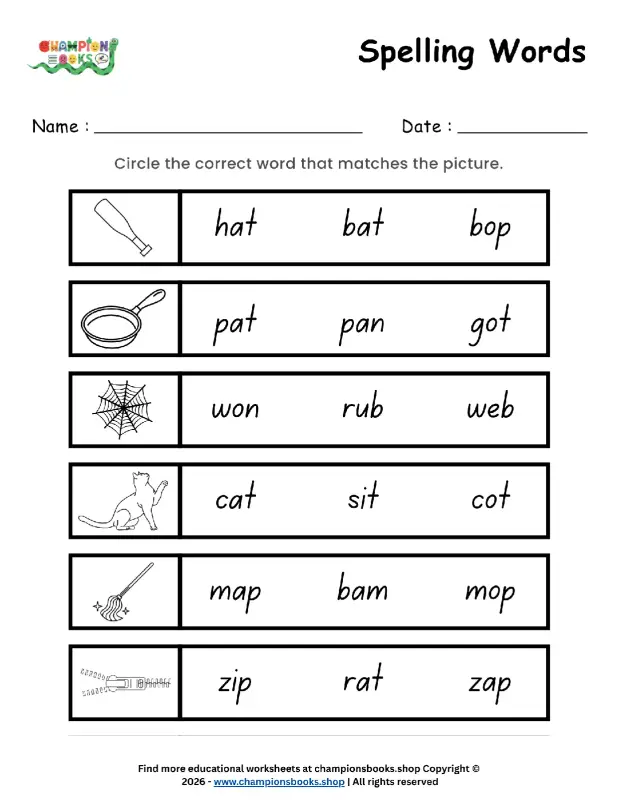
Kindergarten CVC Spelling Words Worksheet: Picture Match
Introduce your little learner to the exciting world of words with our interactive Kindergarten CVC Spelling Words worksheet! This printable activity is specifically crafted to help young students grasp fundamental spelling and reading concepts. About This CVC Spelling Words Worksheet This engaging worksheet provides a wonderful opportunity for Kindergarteners to practice CVC (Consonant-Vowel-Consonant) spelling words. The task is straightforward yet effective: students are presented with charming illustrations and must carefully circle the correct word that accurately matches each picture from a selection of three options. This visual-based approach makes learning accessible and enjoyable.Each row features a clear, black-and-white image of a common object, encouraging children to identify familiar items like a bat pan web cat mop zip . By selecting the correct spelling, children reinforce their understanding of short vowel sounds and basic word structures. It's an excellent resource for building a strong foundation in early literacy and phonics. Key Learning Benefits Enhances Phonics Skills: Children actively engage with letter sounds and their combinations, vital for decoding and encoding CVC words. Boosts Early Reading Fluency: Consistent practice with these simple words builds confidence and helps improve reading speed and comprehension. Expands Core Vocabulary: Reinforces recognition of everyday objects and their corresponding written names, broadening a child's lexicon. Develops Picture-Word Association: Strengthens the crucial connection between visual representations and their written word forms. Improves Fine Motor Skills: The precise act of circling the correct word helps refine hand-eye coordination and pencil control, essential for writing readiness. Fosters Independent Learning: With clear and simple instructions, this worksheet empowers young learners to complete the activity with minimal adult supervision, promoting self-reliance. Perfect for classroom use, homeschooling environments, or as supplemental practice at home, this worksheet ensures that mastering CVC spelling words is both effective and fun. Download and print today to support your Kindergarten student's literacy journey!
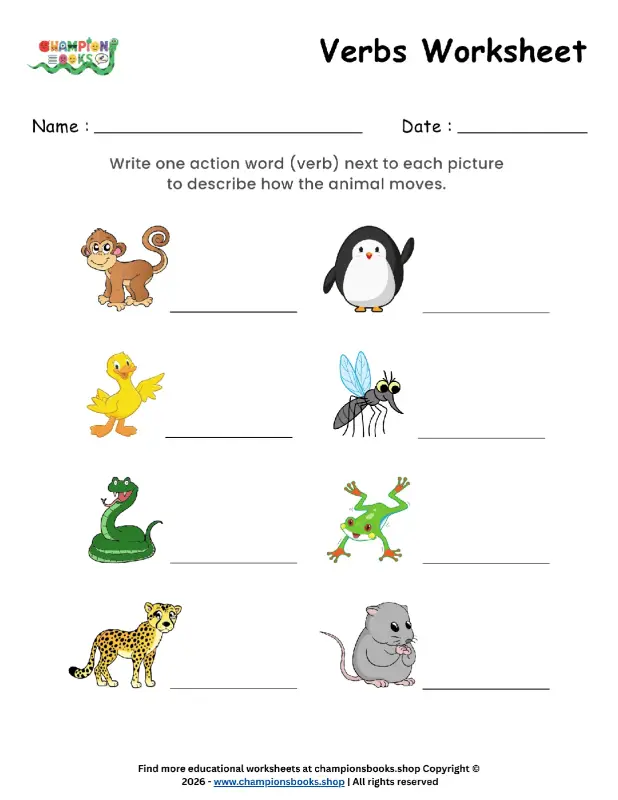
Action Verbs Worksheet for Grade 1 | Identify Animal Actions
About this Verbs Worksheet This engaging Verbs Worksheet is specifically designed to help first-grade students grasp the fundamental concept of action words. Featuring a vibrant collection of eight different animals, this printable activity encourages young learners to identify and write the appropriate verb that describes how each animal moves. From a playful monkey to a waddling penguin, a swimming duck, a buzzing mosquito, a slithering snake, a jumping frog, a sprinting cheetah, and a nibbling mouse, children will explore a variety of animal actions. This makes learning about verbs both fun and interactive, connecting language arts to the natural world. Learning Benefits Utilizing this worksheet provides numerous educational advantages for early learners, making it a valuable addition to any curriculum: Strengthens Grammar Skills: Introduces and reinforces the understanding of verbs as action words, a fundamental component of English grammar and sentence structure. Expands Vocabulary: Encourages students to think creatively and recall various verbs related to movement and actions, enriching their word bank and descriptive abilities. Enhances Observation and Critical Thinking: Requires children to carefully observe each animal and deduce its typical mode of transportation or action, promoting analytical skills. Boosts Writing Proficiency: Provides practical experience in writing words correctly, improving spelling, handwriting, and the ability to express ideas clearly. Supports Early Literacy Development: Builds a solid foundation in parts of speech, which is crucial for overall reading comprehension, effective communication, and more complex sentence construction. How to Use This Resource This versatile worksheet is an excellent resource for both classroom settings and homeschooling environments. Teachers can seamlessly integrate it as a standalone activity, a quick formative assessment, or a focused homework assignment to reinforce lessons on verbs. Parents can use it to supplement their child's learning, reinforcing grammar concepts in an enjoyable and accessible way. Encourage students to discuss the different ways animals move and the various verbs they could use before they write their answers. This fosters deeper understanding, verbal communication skills, and collaborative learning. It's a perfect tool for independent practice, small group work, or even as a warm-up activity for an English language arts lesson.
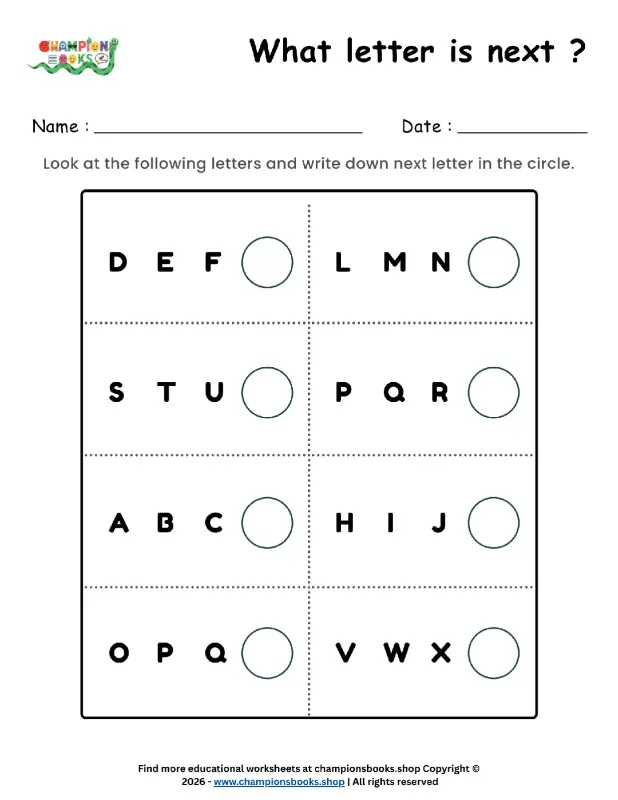
Next Letter Worksheet for Kindergarten | Alphabet Sequence
About this Worksheet This engaging Next Letter Worksheet is specifically designed for Kindergarten students to reinforce their understanding of the alphabet sequence. Children are presented with a series of three uppercase letters and challenged to identify and write the letter that comes next in the sequence. Each of the eight sections on the page provides a clear pattern, such as D-E-F, L-M-N, P-Q-R, or A-B-C, with a blank circle for the student to accurately fill in the correct subsequent letter. This straightforward yet effective activity helps young learners build a strong foundation in alphabetical order. Learning Benefits Utilizing this next letter worksheet offers several key educational advantages for young learners, contributing significantly to their early literacy development: Alphabet Sequence Mastery: Helps children to not only recognize but also memorize the correct sequential order of all uppercase letters, a fundamental skill for reading. Letter Recognition: Strengthens the ability to quickly identify individual letters within a given sequence, improving visual discrimination. Pre-Writing Skills: Provides valuable practice in forming uppercase letters accurately and neatly within a designated space, enhancing fine motor skills. Problem-Solving & Logic: Encourages logical thinking and pattern recognition as students determine the missing element in a familiar sequence. Focus & Concentration: Develops attention span and task completion through a clear, repetitive, and engaging activity. Early Literacy Foundation: Builds essential skills crucial for future reading comprehension, spelling, and writing proficiency. How to Use This Worksheet This versatile Kindergarten next letter worksheet is ideal for various educational settings, including independent practice, small group activities, or as a focused homework assignment. To use, instruct children to carefully observe the three given letters in each box and then thoughtfully write the next letter of the alphabet in the empty circle provided. Encourage them to say the letters aloud as they work to further solidify their auditory and visual association with each letter. This interactive approach makes learning both effective and enjoyable. It's a fantastic, ready-to-print resource for both classroom teachers and homeschooling parents looking to boost early literacy skills and ensure a solid grasp of the alphabet.