
All Worksheets
Browse our complete collection of free printable worksheets
Filter Worksheets
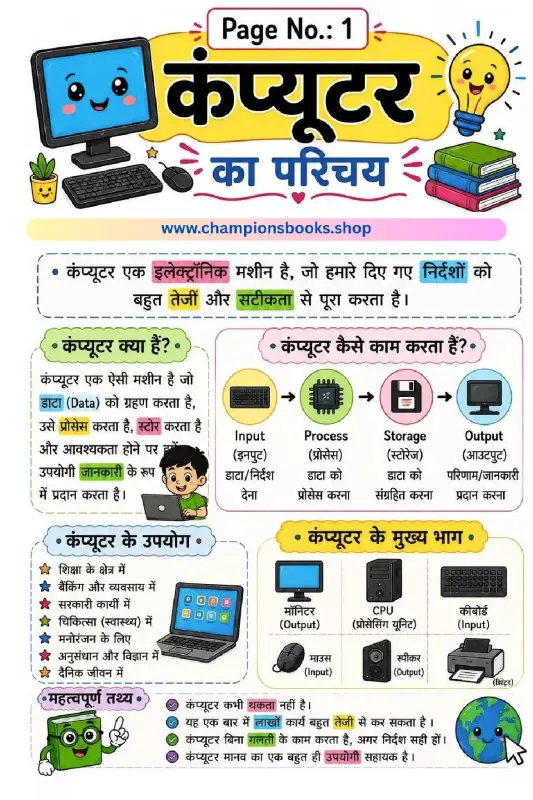
Computer Ka Parichay Worksheet | Kids Computer Basics
About this Worksheet The Computer Ka Parichay Worksheet is an engaging and educational resource designed for young learners, particularly in Grade 1. This colorful Hindi worksheet introduces children to the fundamental concepts of computers in an easy-to-understand format. By utilizing clear illustrations and simple Hindi language, it helps students grasp what a computer is and how it functions in our daily lives. Key Topics Covered This comprehensive worksheet covers essential foundational topics in computer science: What is a Computer? (कंप्यूटर क्या है?): Introduces the computer as an electronic machine that processes data and provides useful information. How Computers Work: Explains the core cycle of Input, Process, Storage, and Output using relatable icons. Main Parts of a Computer (कंप्यूटर के मुख्य भाग): Familiarizes kids with essential hardware components like the Monitor, CPU, Keyboard, Mouse, Speaker, and Printer. Uses of Computers (कंप्यूटर के उपयोग): Highlights where computers are used, such as in education, banking, healthcare, and entertainment. Fun Facts (महत्वपूर्ण तथ्य): Shares interesting trivia, like how computers never get tired and perform tasks with high speed and accuracy. Learning Benefits Using this worksheet offers several educational advantages for primary school students: Builds early digital literacy and computer vocabulary in Hindi. Enhances cognitive skills through visual learning and logical flowcharts. Perfect for classroom teaching, homework assignments, or homeschooling resources.
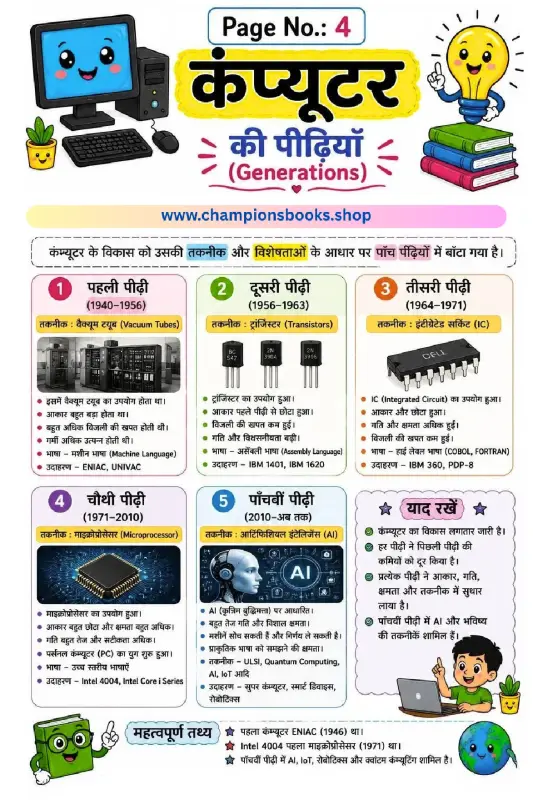
Generations of Computer in Hindi | Learn Computer History
About this Computer Generations Worksheet This colorful and highly engaging educational infographic is designed to help Grade 4 students easily learn about the Generations of Computer in Hindi. Understanding the evolution of technology is a fundamental part of primary school computer science. This worksheet simplifies complex historical milestones into five clear, digestible sections, complete with key highlights, technology used, and real-world examples. Key Features of the 5 Generations of Computers The chart beautifully illustrates how computers evolved over the decades. Students will learn about the technology behind each era: First Generation (1940-1956): Powered by Vacuum Tubes. These computers were massive in size, consumed high electricity, and used machine language. Examples include ENIAC and UNIVAC. Second Generation (1956-1963): Introduced Transistors, making computers smaller, faster, and more energy-efficient. Examples: IBM 1401 and IBM 1620. Third Generation (1964-1971): Utilized Integrated Circuits (ICs), which significantly improved speed and computational capacity. Examples: IBM 360. Fourth Generation (1971-2010): Revolutionized by Microprocessors, paving the way for modern personal computers (PCs). Examples: Intel 4004. Fifth Generation (2010-Present): Focuses on Artificial Intelligence (AI), quantum computing, and advanced robotics. Learning Benefits for Young Minds Using visual study aids like this offers several educational advantages for elementary students: Bilingual Learning: Helps children learn technical computer terms in both Hindi and English. Critical Thinking: Encourages students to compare how size, speed, and efficiency improved with each generation. Exam Readiness: Key facts like the invention of ENIAC are highlighted to help students score better in school tests.
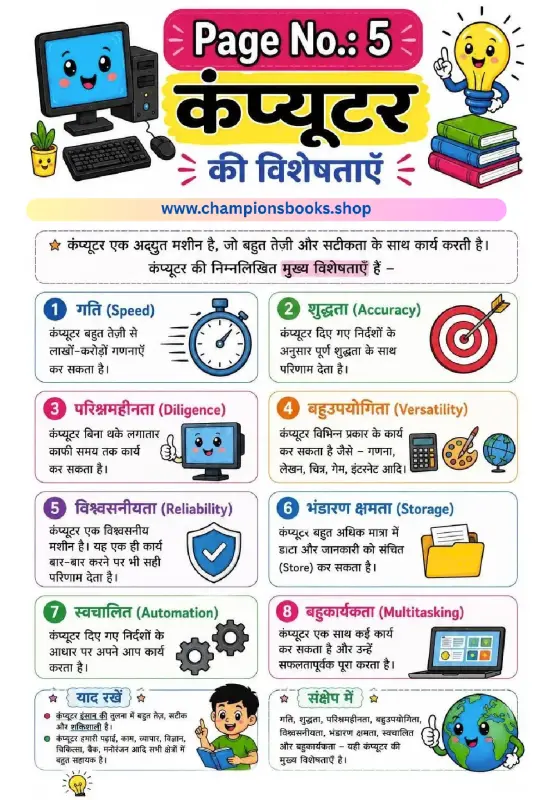
कंप्यूटर की विशेषताएँ - Characteristics of Computer in Hindi
About this Worksheet Introduce young learners to the foundational concepts of computer science with our colorful Characteristics of Computer in Hindi (कंप्यूटर की विशेषताएँ) worksheet. Designed specifically for Grade 3 students, this educational chart makes it easy to understand how computers work and why they are such powerful machines in our daily lives. Key Characteristics of Computer (कंप्यूटर की मुख्य विशेषताएँ) This worksheet highlights eight essential features of a computer in an easy-to-understand Hindi format, accompanied by relatable icons: गति (Speed): कंप्यूटर बहुत तेज़ी से लाखों-करोड़ों गणनाएँ कर सकता है। शुद्धता (Accuracy): कंप्यूटर दिए गए निर्देशों के अनुसार पूर्ण शुद्धता के साथ परिणाम देता है। परिश्रमहीनता (Diligence): कंप्यूटर बिना थके लगातार काफी समय तक कार्य कर सकता है। बहुउपयोगिता (Versatility): कंप्यूटर विभिन्न प्रकार के कार्य कर सकता है जैसे - गणना, लेखन, चित्र, गेम, इंटरनेट आदि। विश्वसनीयता (Reliability): यह एक ही कार्य बार-बार करने पर भी सही परिणाम देता है। भंडारण क्षमता (Storage): कंप्यूटर बहुत अधिक मात्रा में डाटा और जानकारी को संचित (Store) कर सकता है। स्वचालित (Automation): कंप्यूटर दिए गए निर्देशों के आधार पर अपने आप कार्य करता है। बहुकार्यकता (Multitasking): कंप्यूटर एक साथ कई कार्य कर सकता है और उन्हें सफलतापूर्वक पूरा करता है। Learning Benefits Bilingual Vocabulary: Helps children connect Hindi terms with standard English computer terminology like Diligence, Versatility, and Automation. Visual Learning: Engaging illustrations make abstract concepts like storage and processing speed easier for Grade 3 students to grasp. Cognitive Development: Encourages logical thinking and basic computer literacy from an early age.
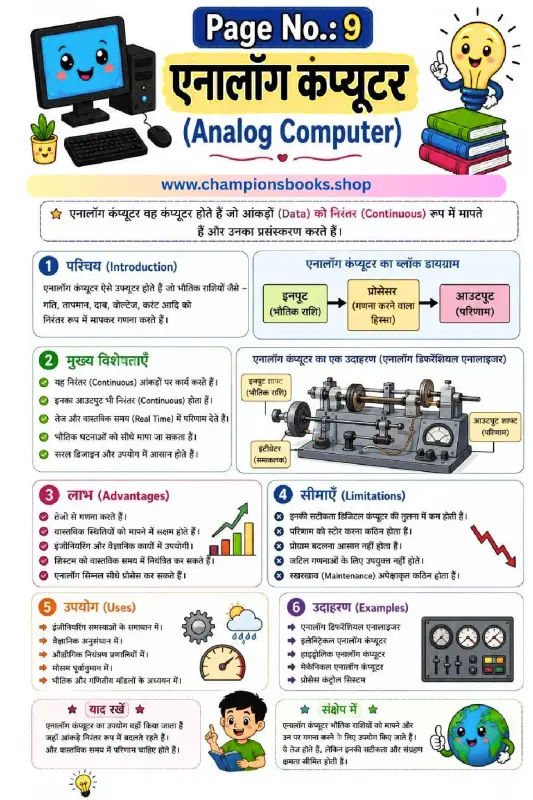
Learn Analog Computer in Hindi - Types, Features & Uses
About this Analog Computer Worksheet This educational worksheet is specifically designed to help Grade 5 students easily grasp the fundamental concepts of an Analog Computer in Hindi (एनालॉग कंप्यूटर). With engaging colorful illustrations, clear block diagrams, and simplified explanations, young learners can effortlessly understand how analog computers measure and process continuous physical data such as speed, temperature, pressure, voltage, and electrical current. Key Learning Benefits By studying this comprehensive Hindi-medium computer science chart, students will explore several vital topics: Definition and Introduction: Learn how analog computers differ from digital ones by processing continuous physical quantities. Detailed Block Diagram: Understand the flow of data from Input (physical quantity) to Processor (calculation) and finally to Output (result). Core Features & Advantages: Discover why these systems are highly valued for real-time results, high-speed calculations, and direct physical measurements. Limitations: Understand their lower accuracy compared to digital computers and the challenges of storing data. Practical Applications & Examples: Explore real-life uses in weather forecasting, industrial control, and scientific research, alongside examples like the Analog Differential Analyzer. Why Use This Hindi Computer Science Guide? Learning technical subjects in Hindi helps students build a stronger foundational understanding. This Analog Computer in Hindi worksheet breaks down complex engineering concepts into easy-to-read bullet points, making it an excellent resource for school teachers, parents, and students looking for quick revision materials.
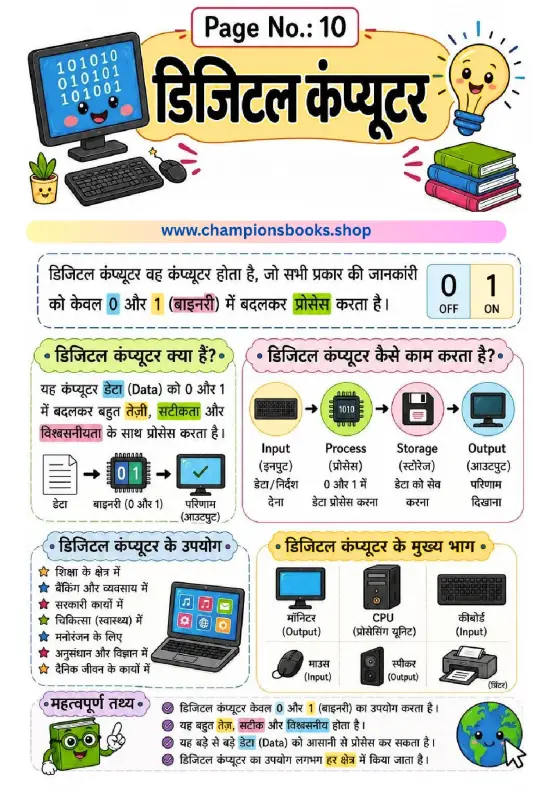
Digital Computer Worksheet in Hindi for Primary Students
About this Digital Computer Worksheet in Hindi Introduce primary school kids to the fascinating world of technology with our colorful Digital Computer Worksheet in Hindi. Designed specifically for young learners, this educational sheet simplifies complex computing concepts like binary language, data processing, and basic computer components in an easy-to-understand Hindi format. Key Concepts Covered This worksheet provides a comprehensive overview of how digital computers function, including: What is a Digital Computer? (डिजिटल कंप्यूटर क्या हैं?): Explaining how computers process data using binary digits 0 and 1 (Off and On). How it Works: Visual representation of the Input, Process, Storage, and Output cycle (इनपुट, प्रोसेस, स्टोरेज, आउटपुट). Parts of a Computer: Identifying crucial hardware components such as the Monitor, CPU, Keyboard, Mouse, Speaker, and Printer. Uses of Computers: Highlighting applications in education, banking, healthcare, entertainment, and research. Learning Benefits Bilingual Understanding: Helps children connect English computer terminology with clear Hindi explanations. Visual Learning: Vibrant illustrations make learning about binary codes and computer parts engaging and memorable. Cognitive Skills: Promotes logical thinking by explaining the step-by-step processing of data. Whether you are a teacher looking for classroom resources or a parent homeschooling your child, this digital computer worksheet serves as an excellent teaching aid. It breaks down technical jargon into bite-sized, child-friendly information that sparks curiosity about technology and computer science.
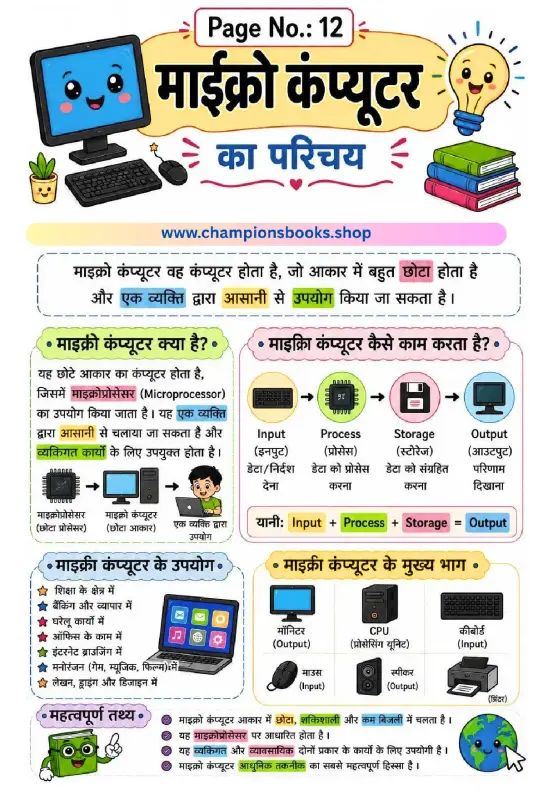
Microcomputer Worksheet in Hindi | Introduction to Computers
This colorful and engaging microcomputer worksheet in hindi is designed specifically for primary school students to introduce them to the world of computers. With vibrant illustrations and clear, simple Hindi text, children can easily grasp the foundational concepts of modern technology. It serves as an excellent teaching aid for parents and teachers alike. About this Worksheet This worksheet provides a comprehensive introduction to microcomputers, explaining their definition, how they function, their main components, and their everyday uses. By breaking down complex technical terms into simple Hindi descriptions, it helps young learners build a strong foundation in computer science. Key Concepts Covered Definition of Microcomputer: Understand what a microcomputer is and how it utilizes a microprocessor for individual tasks. The Computer Cycle: A clear, visual flowchart representing the Input, Process, Storage, and Output cycle. Main Parts of a Computer: Identification of essential hardware components including the Monitor, CPU, Keyboard, Mouse, Speaker, and Printer. Practical Applications: Real-world examples of where microcomputers are used, such as in education, banking, home, office, and entertainment. Learning Benefits Bilingual Understanding: Connects standard Hindi terms with their English technical vocabulary (e.g., Input/इनपुट, Process/प्रोसेस). Visual Learning: Bright, kid-friendly graphics keep students engaged and help them retain information more effectively. Cognitive Development: Encourages logical thinking by explaining how data is processed within a computer system.
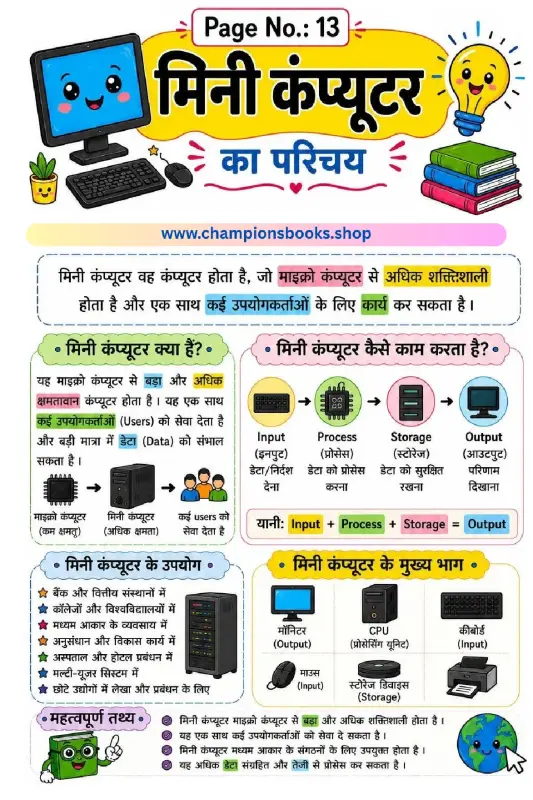
Mini Computer in Hindi - मिनी कंप्यूटर का परिचय Worksheet
About this Worksheet: मिनी कंप्यूटर का परिचय This educational worksheet is designed to introduce young learners to the concept of a Mini Computer in Hindi. Specially crafted for elementary school students, this colorful study guide explains what a mini computer is, how it functions, and where it is used in daily life. With clear diagrams and simplified Hindi text, children can easily grasp complex computer science concepts. Learning Benefits and Key Topics Covered This worksheet serves as an excellent teaching resource for parents and educators to teach basic computer architecture. Here are the key topics covered in this guide: What is a Mini Computer? (मिनी कंप्यूटर क्या है): Learn how it is more powerful than a microcomputer and supports multiple users simultaneously. How it Works: A simple breakdown of the Input, Process, Storage, and Output cycle. Main Components: Identification of key parts like the Monitor, CPU, Keyboard, Mouse, Storage Device, and Printer. Uses of Mini Computers: Real-world applications in banks, colleges, medium-sized businesses, hospitals, and research facilities. Why Use This Hindi Computer Worksheet? Introducing technology concepts in a native language helps students build a stronger foundational understanding. This worksheet uses visual aids, color-coded highlights, and an engaging layout to keep students interested. The "Important Facts" (महत्वपूर्ण तथ्य) section at the bottom provides a quick summary, perfect for revision before exams or quizzes.
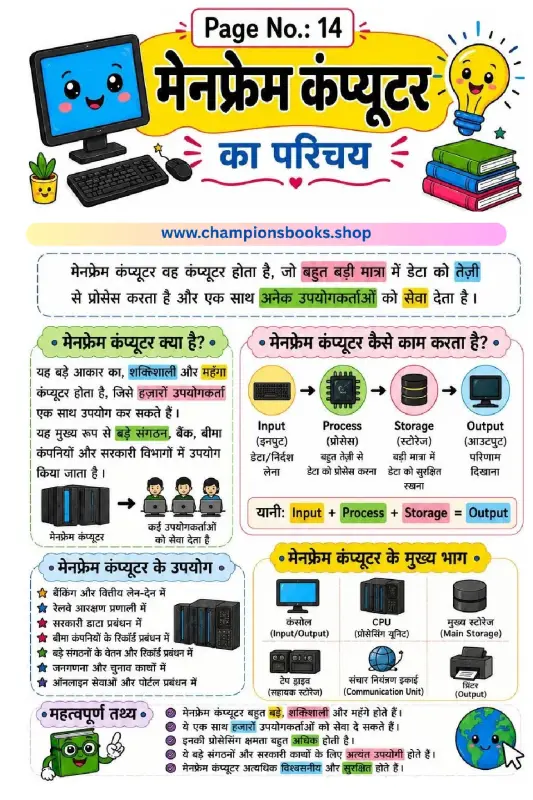
Learn Mainframe Computer Worksheet in Hindi for Class 4
About this Worksheet Introduce your elementary students to advanced technology with our engaging Mainframe Computer Worksheet in Hindi. Tailored specifically for Grade 4 students, this high-quality educational resource simplifies complex computer science concepts into easy-to-understand Hindi text, supported by colorful illustrations and clear diagrams. It is an excellent resource for Hindi-medium schools and bilingual learners looking to strengthen their computer literacy. Learning Benefits This worksheet serves as a comprehensive guide to understanding large-scale computing systems. Here are the key learning outcomes: Concept of Mainframes: Kids will learn what a mainframe computer is, highlighting its immense processing power, size, and cost. The Computing Cycle: Visual flowcharts teach the fundamental cycle of Input, Process, Storage, and Output in a simple, memorable way. Key Hardware Components: Introduces vital parts of a mainframe system including the Console, CPU, Main Storage, Tape Drive, Communication Unit, and Printer. Real-World Applications: Helps students connect theory to real life by showcasing how mainframes are used in banking, railway reservations, census operations, and government databases. Interactive Classroom Features Vibrant Visuals: Keeps young learners engaged with cute computer characters and clear icons. Key Facts Summary: Includes a "महत्वपूर्ण तथ्य" (Important Facts) section for quick revision and exam preparation. Bilingual Advantage: Helps students learn technical computer terms in both Hindi and English.
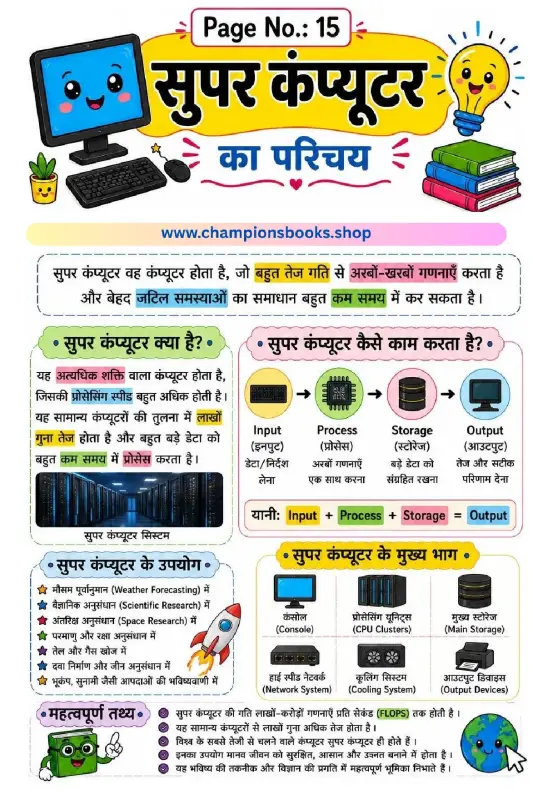
Super Computer in Hindi: Introduction & Uses Worksheet
About this Worksheet This educational worksheet is designed to introduce young learners to the fascinating world of supercomputers. Written in clear, easy-to-understand Hindi, "सुपर कंप्यूटर का परिचय" (Introduction to Supercomputer) helps students grasp advanced computer science concepts with engaging visuals and structured diagrams. It is an excellent resource for classrooms, homeschooling, and computer science clubs. Key Learning Benefits Easy Comprehension: Complex technology concepts are explained using simple Hindi terminology and clear diagrams. Visual Learning: Features engaging illustrations detailing the input-process-storage-output cycle and key supercomputer components. Real-World Connections: Helps students understand how supercomputers assist in global scientific advancement. What is Covered in this Guide? What is a Supercomputer? Understanding its high-speed processing capabilities and how it differs from normal PCs. How it Works: A step-by-step flowchart showing the Input, Process, Storage, and Output stages. Major Components: Introduction to CPU clusters, main storage, cooling systems, and console units. Important Uses: Real-world applications like weather forecasting (मौसम पूर्वानुमान), space research (अंतरिक्ष अनुसंधान), and medicine. Fascinating Facts: Fun facts like measuring supercomputer speed in FLOPS (Floating-Point Operations Per Second).
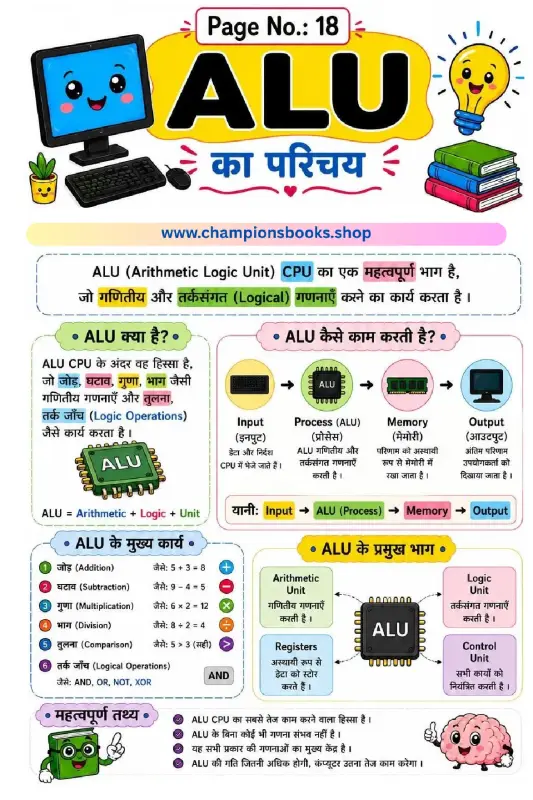
What is ALU in Computer? Educational Hindi Worksheet
About this Worksheet Introduce young learners to the core of computer processing with our engaging ALU in Computer educational worksheet. Designed specifically for primary school students (Grade 4), this colorful Hindi-medium guide simplifies complex computer hardware concepts into easy-to-understand visual diagrams. It is an excellent resource for teachers and parents looking to build a strong foundation in computer science. What is an Arithmetic Logic Unit (ALU)? The Arithmetic Logic Unit (ALU) is a critical component of the Central Processing Unit (CPU). Often described as the calculator of the computer, the ALU is responsible for performing all mathematical computations and logical decision-making processes that keep our devices running smoothly. Key Learning Benefits and Features Data Flow Visualization: Kids will learn how information travels through a computer system via the clear Input → Process (ALU) → Memory → Output cycle diagram. Mathematical Operations: Understands how computers execute basic arithmetic functions like Addition, Subtraction, Multiplication, and Division. Logical Reasoning: Explains how computers compare data using logical operations such as AND, OR, NOT, and XOR. Anatomy of the ALU: Highlights the four main pillars of the processing unit: the Arithmetic Unit, Logic Unit, Registers, and Control Unit. Bilingual Learning: Uses a mix of Hindi and English terminology to help students transition easily to advanced computer science topics. Why Use This Worksheet? With vibrant illustrations and child-friendly explanations, this worksheet turns dry technical concepts into an interactive visual learning experience. It helps students understand that without the ALU, a computer cannot perform any calculations or execute logical commands!
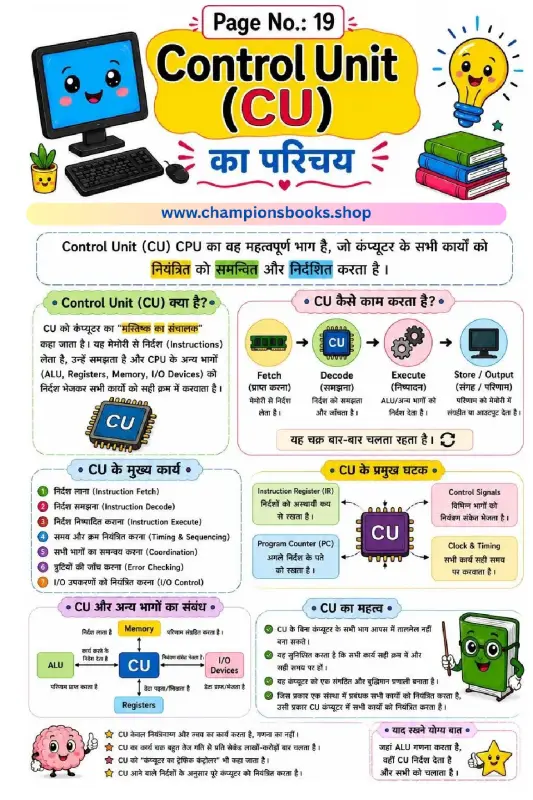
Computer Control Unit Worksheet: Learn CU Basics in Hindi
About this Worksheet Introduce young learners to the core of computer processing with our engaging Computer Control Unit Worksheet. Designed specifically for elementary students, this worksheet explains the concept of the Control Unit (CU) as the 'conductor' of the computer's brain. Written in clear, easy-to-understand Hindi with standard English technical terms, it provides a perfect foundation in computer science basics. Key Learning Concepts This worksheet breaks down complex computer architecture into simplified, visual segments, covering: What is a Control Unit (CU)?: Understanding how the CU manages, coordinates, and directs all activities of a computer. The CU Working Cycle: A step-by-step visual representation of the Fetch, Decode, Execute, and Store process. Main Functions of the CU: Learn about instruction fetching, timing and sequencing, error checking, and I/O device control. Key Components: Introduction to the Instruction Register (IR), Program Counter (PC), Control Signals, and Clock & Timing. System Interconnection: How the CU interacts with the ALU, Memory, Registers, and Input/Output devices. Learning Benefits for Kids Using this worksheet offers several educational advantages for elementary students: Visual Diagrams: The colorful flowcharts and illustrations help children visualize how data moves inside a CPU. Bilingual Learning: Dual-language explanations (Hindi and English) ensure children grasp complex technical terms easily. Logical Thinking: Encourages logical thinking by showing how step-by-step instructions are processed in a cycle. How to Use This Worksheet in the Classroom Teachers and parents can use this Computer Control Unit Worksheet to introduce basic CPU architecture. Start by explaining the analogy of a school principal or traffic controller (as highlighted in the sheet) to help children relate to the CU's role. Follow up with a fun quiz asking students to list the four stages of the CU cycle in order!
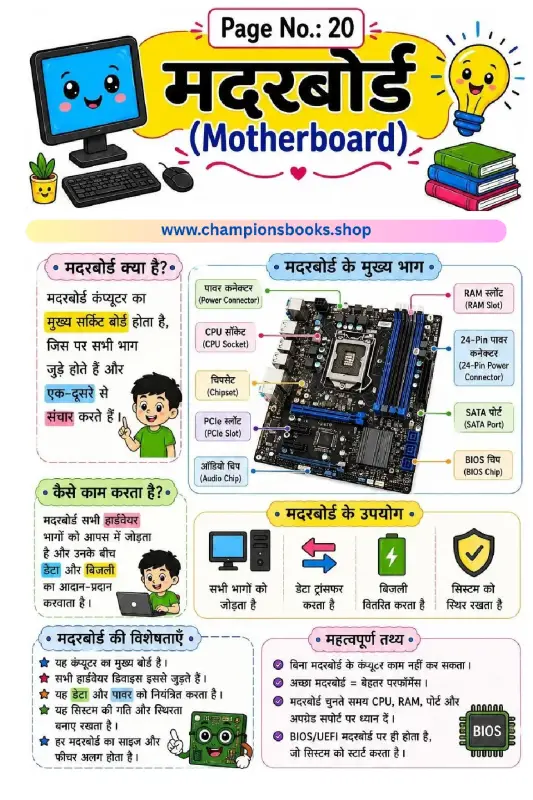
Learn Computer Motherboard Worksheet in Hindi | Grade 4
About this Computer Motherboard Worksheet Introduce young learners to the heart of the computer with our colorful and educational computer motherboard worksheet in hindi. Designed specifically for Grade 4 students, this visually engaging chart breaks down complex hardware concepts into simple, easy-to-understand Hindi terms. It is the perfect resource for teachers and parents to teach kids how a computer's main circuit board operates. Key Learning Benefits Interactive Learning: Beautifully labeled diagrams of motherboard parts like CPU Socket, RAM Slot, and BIOS Chip keep students engaged. Bilingual Understanding: Terms are presented in both Hindi and English to build strong vocabulary in both languages. Conceptual Clarity: Explains how a motherboard functions, distributes electricity, and transfers data between components. Quick Facts: Includes a dedicated section with important facts about motherboard performance and system stability. What this Worksheet Covers This comprehensive worksheet covers essential topics about computer hardware, including: What is a Motherboard? (मदरबोर्ड क्या है?): Understanding the main circuit board of a computer. Main Parts of a Motherboard: Visual identification of the Power Connector, Chipset, SATA Port, and PCIe Slot. How it Works (कैसे काम करता है?): Explaining the flow of data and power across hardware devices. Features & Importance: Why a computer cannot function without a motherboard and how it maintains system stability.
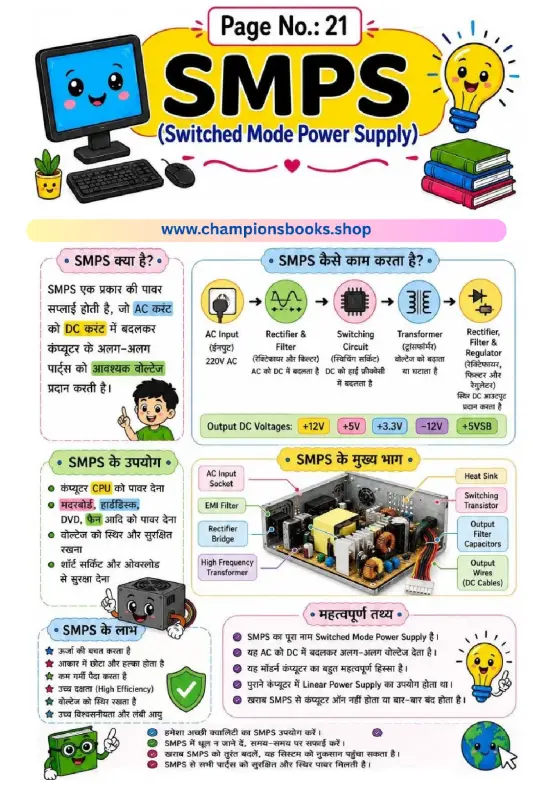
SMPS Computer Parts Worksheet in Hindi for Grade 5
About this SMPS Computer Parts Worksheet This highly engaging and colorful educational worksheet is specifically designed for Grade 5 students learning about computer hardware in Hindi. It provides a comprehensive, visual, and easy-to-understand breakdown of an SMPS (Switched Mode Power Supply), helping young learners grasp complex electrical and computer engineering concepts in their native language. Key Learning Sections Covered This worksheet serves as an excellent study guide by dividing the topic of computer power supplies into digestible sections: What is SMPS (SMPS क्या है?): An introductory explanation of how the device converts Alternating Current (AC) to Direct Current (DC) to power various internal computer components safely. Working Mechanism (SMPS कैसे काम करता है?): A clear step-by-step block diagram showcasing the flow from AC Input (220V) through the Rectifier, Switching Circuit, Transformer, and Regulator to deliver precise output DC voltages (+12V, +5V, +3.3V, etc.). Main Components (SMPS के मुख्य भाग): A labeled diagram pointing out essential hardware parts such as the EMI Filter, Heat Sink, High-Frequency Transformer, and Output Wires. Uses and Benefits (SMPS के उपयोग और लाभ): Real-world applications like protecting the motherboard and CPU from overload, and advantages such as high energy efficiency and lightweight design. Why Use This Worksheet? Integrating this SMPS computer parts worksheet in Hindi into your curriculum or home-schooling routine helps students build technical vocabulary, understand fundamental hardware operations, and prepare for advanced computer science topics. It is perfect for classroom activities, quick revisions, and homework assignments.
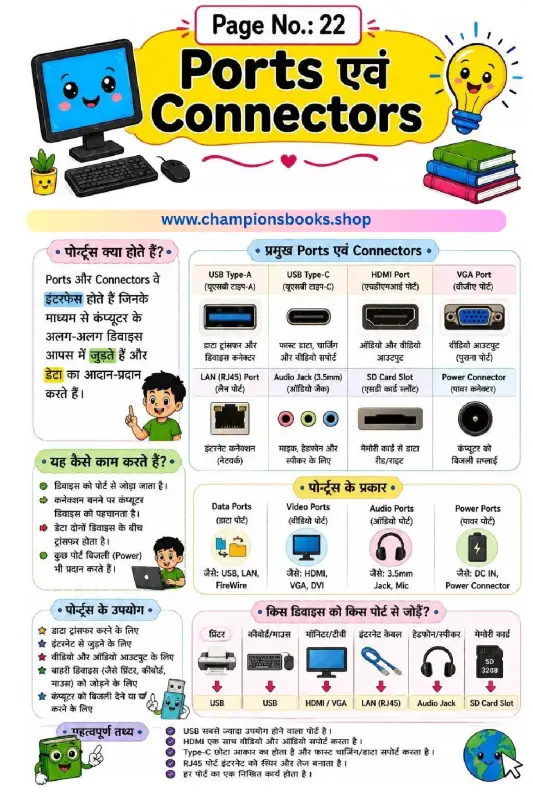
Computer Ports and Connectors in Hindi - Grade 3 Worksheet
About this Computer Ports and Connectors Worksheet This educational worksheet is designed to teach Grade 3 students about essential computer hardware components: Computer Ports and Connectors in Hindi. With colorful illustrations and easy-to-understand bilingual explanations, young learners can quickly grasp how different devices connect to a computer system to transfer data and power. Key Learning Topics Covered What are Ports? (पोर्ट्स क्या होते हैं?): Learn how ports act as interfaces to connect external devices and transfer data. How Ports Work: Understand the connection process and data transfer mechanism between devices. Types of Ports: Discover the classification into Data Ports, Video Ports, Audio Ports, and Power Ports. Major Connectors: Visual identification of USB Type-A, USB Type-C, HDMI, VGA, LAN (RJ45), Audio Jack, and SD Card Slots. Device Compatibility: Practical guide on which device (printer, keyboard, monitor, headphones) connects to which specific port. Benefits of this Worksheet Learning about computer hardware at an early age builds a strong foundation in computer literacy. This worksheet offers several key benefits: Bilingual Learning: Explanations are provided in Hindi with English terms, making it highly accessible for Hindi-medium students. Visual Reinforcement: High-quality, cute illustrations help children easily identify physical ports on their school or home computers. Practical Knowledge: Students learn real-world applications, such as how to connect a mouse, keyboard, or monitor. Fun and Interactive Computer Science Study Guide Whether used in the classroom or for homeschooling, this worksheet serves as an excellent study guide. It simplifies complex technical terms into digestible, kid-friendly facts, such as how USB is the most widely used port and how HDMI supports both video and audio transmission. Perfect for Grade 3 computer science lessons!
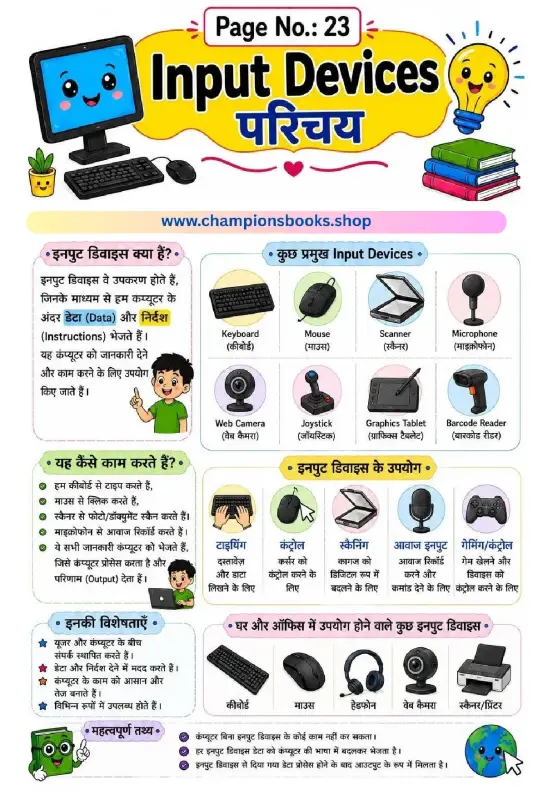
Computer Input Devices in Hindi | Kids Learning Chart
About this Input Devices in Hindi Worksheet Introduce young learners to the basics of computer science with our engaging Computer Input Devices in Hindi educational worksheet. Designed specifically for elementary school students (Grade 3 to Grade 5), this visually appealing chart helps children understand how we interact with computers using various input tools. The worksheet features clear Hindi explanations alongside colorful illustrations of common devices like the keyboard, mouse, scanner, and microphone. Key Learning Benefits Concept Clarity: Clearly explains what input devices are (इनपुट डिवाइस क्या हैं?) and how they send data and instructions to the computer. Visual Identification: Helps kids easily identify 8 major input devices including Keyboard, Mouse, Scanner, Microphone, Web Camera, Joystick, Graphics Tablet, and Barcode Reader. Practical Knowledge: Demonstrates real-world uses such as typing, controlling cursors, scanning documents, recording voice, and gaming. Bilingual Support: Features terms in both Hindi and English script to build a stronger technical vocabulary. Worksheet Features Highly interactive layout with cute graphics to keep children engaged. Easy-to-understand bullet points highlighting the main characteristics (विशेषताएँ) of input devices. "Important Facts" (महत्वपूर्ण तथ्य) section to reinforce critical concepts, like why a computer cannot function without input devices. Perfect for classroom teaching, homeschooling, or self-study. How to Use This Worksheet Teachers and parents can use this chart to initiate an interactive discussion about computer hardware. Ask students to point out the input devices they use at home or in the school lab. This resource serves as an excellent reference sheet for homework, computer science quizzes, and classroom displays.
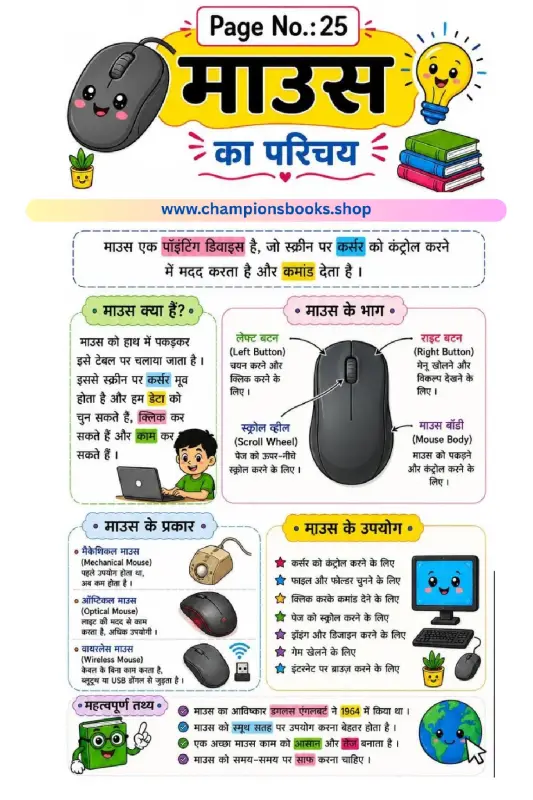
Computer Mouse Worksheet in Hindi: Learn Mouse Parts
About the Computer Mouse Worksheet in Hindi Introduce young learners to the basics of technology with our colorful Computer Mouse Worksheet in Hindi. Designed specifically for elementary school students, this worksheet provides a comprehensive yet easy-to-understand introduction to the computer mouse, known as "माउस का परिचय". Through engaging diagrams and child-friendly Hindi text, children will easily grasp how this essential pointing device works. What Kids Will Learn Parts of a Mouse: Learn about the Left Button (लेफ्ट बटन), Right Button (राइट बटन), Scroll Wheel (स्क्रोल व्हील), and Mouse Body (माउस बॉडी). Types of Mice: Understand the differences between Mechanical, Optical, and Wireless mice. Functions & Uses: Discover how a mouse helps in controlling the cursor, opening files, scrolling pages, drawing, and playing games. Fun Facts: Did you know the computer mouse was invented by Douglas Engelbart in 1964? This worksheet covers interesting historical facts to spark curiosity. Interactive Learning Benefits Using visual aids is one of the most effective ways to teach young kids. This worksheet uses vibrant colors, cute illustrations, and clear labeling to make learning about computer hardware an enjoyable experience. It is perfect for classroom activities, homeschooling, or quick revision sessions for Grade 2 students to boost their digital literacy skills.
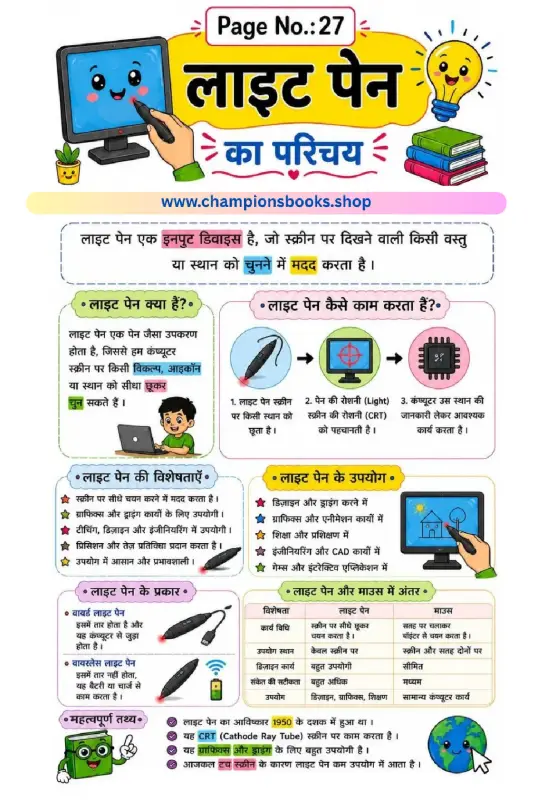
Light Pen in Hindi: Computer Worksheet for Grade 3
लाइट पेन का परिचय - Introduction to Light Pen in Hindi क्या आप जानते हैं कि कंप्यूटर पर सीधे स्क्रीन को छूकर काम करने के लिए किस इनपुट डिवाइस का उपयोग किया जाता है? इस रंगीन और शैक्षिक Light Pen in Hindi वर्कशीट के माध्यम से बच्चे बहुत ही आसान भाषा में लाइट पेन के बारे में सब कुछ सीख सकते हैं। यह वर्कशीट विशेष रूप से प्राथमिक कक्षा (Grade 3) के छात्रों के लिए कंप्यूटर विज्ञान के बुनियादी सिद्धांतों को समझाने के लिए तैयार की गई है। इस वर्कशीट की मुख्य विशेषताएं (Key Features) लाइट पेन क्या है?: सरल शब्दों में परिभाषा कि यह एक पेन जैसा इनपुट डिवाइस है जिससे स्क्रीन पर सीधे विकल्पों को चुना जा सकता है। कार्यप्रणाली (Working Process): चित्रों के माध्यम से चरण-दर-चरण समझाया गया है कि लाइट पेन स्क्रीन की रोशनी को कैसे पहचानता है। लाइट पेन की विशेषताएं और उपयोग: ड्राइंग, ग्राफ़िक्स, एनिमेशन, इंजीनियरिंग (CAD), और शिक्षा के क्षेत्र में इसके उपयोगों की विस्तृत जानकारी। लाइट पेन और माउस में अंतर: एक सरल तुलनात्मक तालिका के माध्यम से दोनों इनपुट डिवाइसेस के बीच का अंतर स्पष्ट किया गया है। महत्वपूर्ण तथ्य: लाइट पेन के इतिहास, आविष्कार (1950 के दशक) और CRT स्क्रीन के साथ इसके संबंध के बारे में रोचक तथ्य। सीखने के लाभ (Learning Benefits) यह वर्कशीट बच्चों में विजुअल लर्निंग (Visual Learning) को बढ़ावा देती है। रंग-बिरंगे चित्रों और स्पष्ट हिंदी अनुवाद के साथ, छात्र कंप्यूटर विज्ञान के इस महत्वपूर्ण विषय को आसानी से समझ और याद रख सकते हैं। शिक्षकों और अभिभावकों के लिए यह वर्कशीट बच्चों को डिजिटल साक्षरता (Digital Literacy) की ओर ले जाने का एक शानदार और आकर्षक जरिया है।
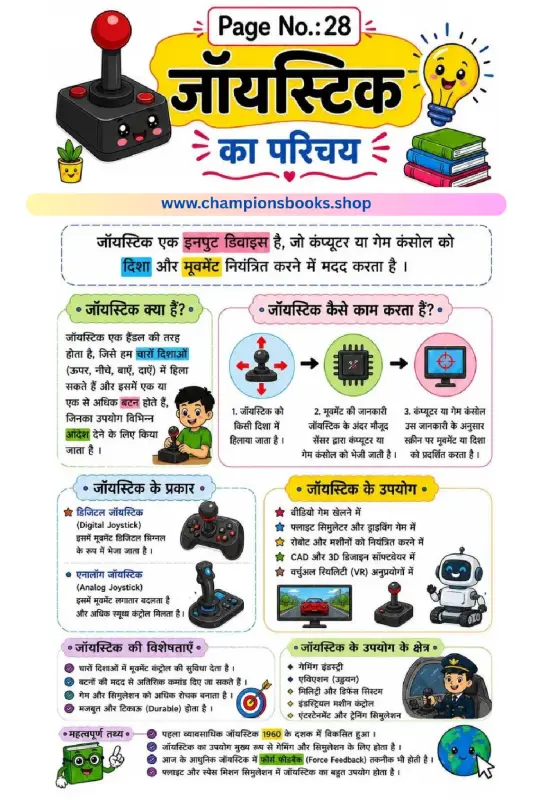
Learn About Joystick: Hindi Computer Worksheet for Kids
About this Worksheet: Introduction to Joystick This colorful and engaging educational worksheet is designed to introduce young learners to the computer joystick in Hindi. Perfect for primary school students, this page provides a comprehensive yet easy-to-understand breakdown of how a joystick functions as an essential input device. Key Topics Covered What is a Joystick? (जॉयस्टिक क्या हैं?): Learn how this handle-like device controls movement in four directions. How It Works (जॉयस्टिक कैसे काम करता हैं?): A simple 3-step visual guide showing how movement signals are sent to the computer screen. Types of Joysticks (जॉयस्टिक के प्रकार): Discover the differences between Digital and Analog joysticks. Uses and Applications (जॉयस्टिक के उपयोग): Explore where joysticks are used, from video games and flight simulators to robotics and Virtual Reality (VR). Key Features & Facts (विशेषताएँ और महत्वपूर्ण तथ्य): Fun facts, including the history of the joystick from the 1960s and modern force feedback technology. Educational Benefits Bilingual Learning: Helps kids connect English technical terms with Hindi explanations. Visual Aids: Bright illustrations of joysticks, robots, and airplanes keep young minds engaged. Foundational Computer Skills: Introduces core hardware concepts like input devices in an approachable format.
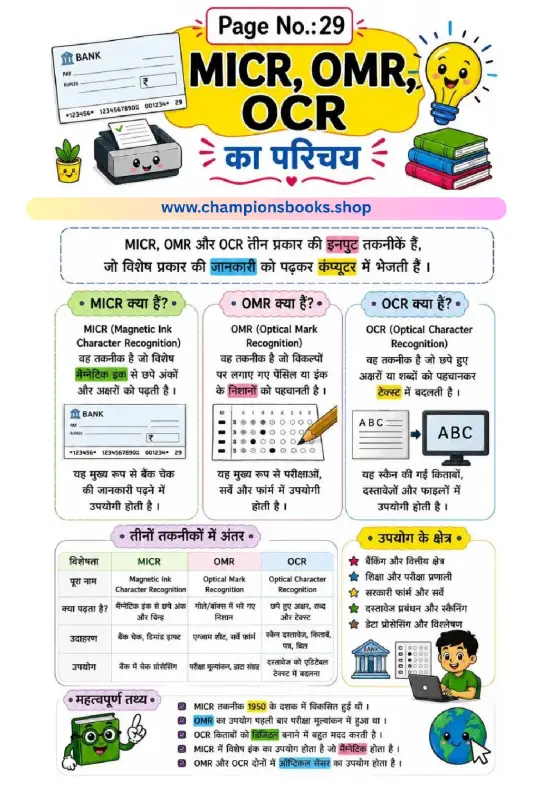
Learn MICR OMR OCR in Hindi - Grade 4 Computer Worksheet
About this Worksheet This educational worksheet is designed to introduce young learners, particularly in Grade 4, to advanced computer input technologies: MICR, OMR, and OCR in Hindi. It provides a clear, visual, and easy-to-understand breakdown of how these specialized input devices read data and send it to computers. Written in accessible Hindi with helpful illustrations, it is perfect for classroom learning, computer lab activities, or home study. Key Concepts Covered The worksheet covers the fundamental aspects of these three vital data-reading technologies: MICR (Magnetic Ink Character Recognition): Explains how magnetic ink is used to read bank check details quickly and securely. OMR (Optical Mark Recognition): Details how pencil or pen marks are detected on test answer sheets and survey forms. OCR (Optical Character Recognition): Shows how printed text from scanned books and documents is converted into editable digital text. Comparison Table: A handy reference comparing the full names, reading capabilities, practical examples, and primary uses of all three technologies. Applications & Facts: Highlights real-world use cases in banking, education, and document management, along with interesting historical facts. Learning Benefits Using this worksheet, students will gain valuable technological literacy and academic skills: Understand the practical, real-world applications of computer science in everyday systems like banking and examinations. Enhance bilingual vocabulary with key technical terms explained in both Hindi and English. Improve comparative analytical skills through the structured differences table. Spark curiosity about digital scanning, automation, and modern data processing systems.
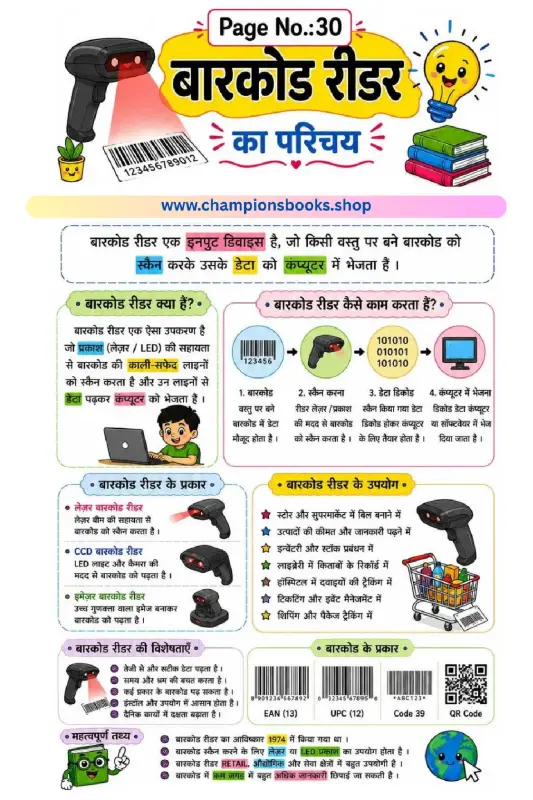
Barcode Reader Worksheet in Hindi | Computer Basics
About this Worksheet Introduce young learners to essential computer hardware concepts with our comprehensive Barcode Reader Worksheet in Hindi. Designed specifically for primary school students, this colorful and highly visual educational poster explains the fundamental concepts of barcode technology in easy-to-understand Hindi. It serves as an excellent resource for computer science classes, helping kids grasp how everyday technology works in supermarkets, libraries, and shipping centers. What You Will Learn This worksheet covers all the critical aspects of barcode readers, broken down into child-friendly sections: What is a Barcode Reader? (बारकोड रीडर क्या है?): An engaging introduction to this essential input device. How it Works: A step-by-step visual workflow from scanning to decoding and sending data to a computer. Types of Barcode Readers: Learn about Laser, CCD, and Imager barcode readers. Common Uses: Real-world applications in retail billing, inventory management, library records, and shipping. Types of Barcodes: Introduces standard barcode types like EAN, UPC, Code 39, and modern QR Codes. Learning Benefits Visual Learning: Vibrant diagrams and cute illustrations keep kids engaged and aid in information retention. Bilingual Understanding: Helps Hindi-medium students master technical computer terms with clear definitions. Practical Knowledge: Connects classroom computer science lessons with real-world technology they see daily. Perfect for Teachers and Parents Whether you are a school teacher looking for a classroom display chart or a parent homeschooling your child, this Barcode Reader Worksheet in Hindi is the perfect teaching aid. Download or print this resource to make learning about computer input devices interactive, fun, and highly educational!
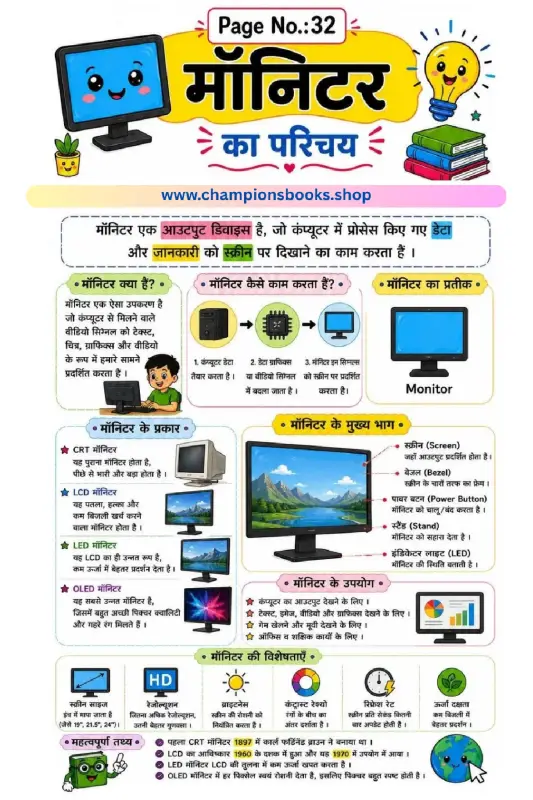
Learn Computer Monitor in Hindi: Types & Parts Guide
About this Computer Monitor Worksheet This beautifully designed educational worksheet introduces young learners to the Computer Monitor in Hindi (मॉनिटर का परिचय). Tailored for primary school students, particularly Grade 3, it simplifies complex computer hardware concepts into easy-to-understand visual sections. A monitor is an essential output device that displays processed data and information on the screen, and this chart covers all its fundamental aspects. Key Learning Topics Covered What is a Monitor? (मॉनिटर क्या है?): Understanding how it displays text, graphics, and video signals from the computer. How it Works (मॉनिटर कैसे काम करता है?): Step-by-step visual representation of data processing to screen display. Types of Monitors (मॉनिटर के प्रकार): Introduction to different screen technologies including CRT, LCD, LED, and OLED. Main Parts (मॉनिटर के मुख्य भाग): Identifying key components like the screen, bezel, power button, stand, and LED indicator. Features & Specifications (मॉनिटर की विशेषताएँ): Basics of screen size, resolution, brightness, contrast ratio, refresh rate, and energy efficiency. Learning Benefits for Kids Using visual aids like this worksheet helps students grasp computer science basics effortlessly. By studying the Computer Monitor in Hindi, children will: Develop a clear understanding of computer output devices. Learn to differentiate between older CRT monitors and modern OLED displays. Enhance their technical vocabulary in both Hindi and English. Build a strong foundation for elementary school computer science exams. Whether you are a teacher looking for classroom resources or a parent helping with homework, this comprehensive guide makes learning about computer hardware engaging and fun. Reference this chart to boost your child's digital literacy today!
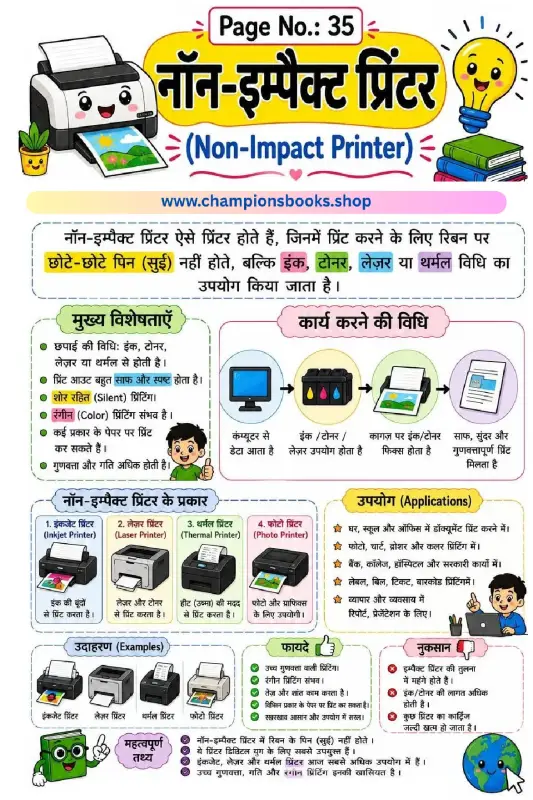
Non-Impact Printer Worksheet in Hindi | Grade 4 Computer
About this Non-Impact Printer Worksheet in Hindi This colorful and engaging Non-Impact Printer Worksheet in Hindi is designed for Grade 4 students to help them understand basic computer hardware concepts. It provides a comprehensive overview of non-impact printers, their working mechanisms, types, and real-world applications in simple, easy-to-understand Hindi with clear visual aids. What is a Non-Impact Printer? A non-impact printer is a modern type of printer that does not hit or impact a ribbon to print on paper. Instead, it uses advanced technologies like laser beams, electrostatic charges, inkjet sprays, or heat to produce high-quality text and graphics silently and quickly. This worksheet explains these complex concepts using relatable daily-life examples. Learning Benefits Understand Printer Technology: Learn how non-impact printers use ink, toner, laser, or thermal methods instead of traditional ribbons. Explore Different Types: Discover the four main types of non-impact printers: Inkjet Printer, Laser Printer, Thermal Printer, and Photo Printer. Learn the Working Process: Step-by-step visual representation of how data from a computer is converted into high-quality prints. Pros and Cons: Understand the advantages (high quality, silent printing) and disadvantages (cost of ink/cartridges) of using these devices. How to Use This Worksheet This worksheet is an excellent resource for computer science teachers and homeschooling parents. You can use it to introduce the topic of computer output devices, conduct interactive classroom discussions, or as a handy revision guide. The visual flowcharts and colorful illustrations make complex technical concepts highly accessible for young learners.
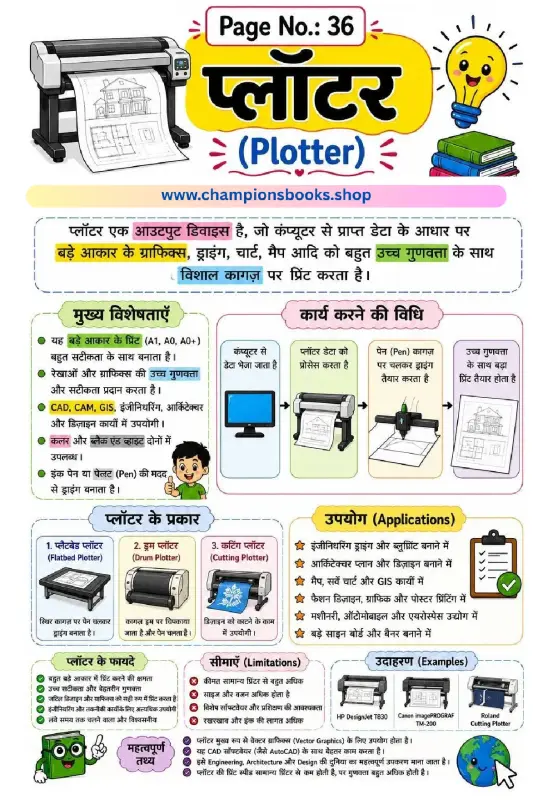
Plotter in Hindi: Computer Output Device Worksheet
About this Plotter (प्लॉटर) Worksheet This educational worksheet is designed to help students understand the Plotter (प्लॉटर), a crucial computer output device used for printing high-quality, large-scale graphics, architectural designs, and maps. Written in clear and accessible Hindi, this resource is perfect for elementary and middle school students learning basic computer hardware concepts. Key Features of a Plotter The worksheet comprehensively covers the essential characteristics of a plotter, making it easy for young learners to grasp: High-Quality Output: Explains how plotters provide exceptional accuracy and precision for large prints (A1, A0, A0+). Vector Graphics: Highlights why plotters are ideal for CAD, CAM, GIS, engineering, and architectural designs. Pen-Based Drawing: Illustrates how plotters use ink pens or plotters to create drawings instead of standard toner. Types and Applications Covered Students will explore different types of plotters and their real-world applications through clear diagrams and flowcharts: Flatbed Plotter: Draws on flat paper placed on a bed. Drum Plotter: Prints on paper wrapped around a rotating drum. Cutting Plotter: Specifically designed for cutting vinyl and other materials. Common Uses: Engineering blueprints, GIS mapping, fashion design, and large banner printing. Learning Benefits By studying this visual worksheet, students will not only learn the definition of a plotter but also its advantages, limitations, and real-world examples like HP DesignJet and Canon imagePROGRAF. It serves as an excellent study guide for school computer exams and general knowledge quizzes.
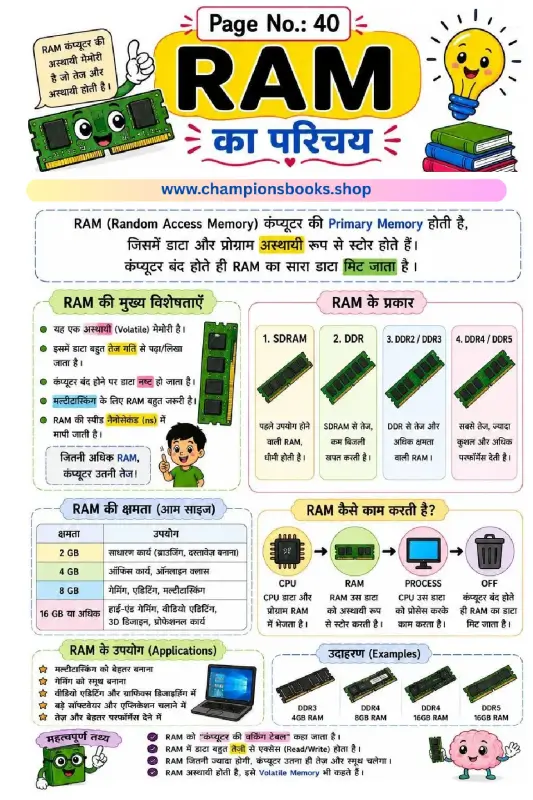
Interactive Computer RAM Worksheet in Hindi for Grade 4
About this Computer RAM Worksheet in Hindi Introduce young learners to the core concepts of computer hardware with our engaging Computer RAM Worksheet in Hindi. Designed specifically for Grade 4 students, this colorful study guide simplifies complex computer science topics like primary memory and temporary data storage using easy-to-understand Hindi explanations and vibrant illustrations. What Students Will Learn This comprehensive worksheet covers all the essential aspects of Random Access Memory (RAM), helping students build a strong foundation in computer literacy: What is RAM? Learn that RAM is the primary, volatile memory of a computer that stores data temporarily. Key Features of RAM: Understand how speed is measured in nanoseconds and why data disappears when the computer is turned off. Types of RAM: Explore the evolution of memory from older SDRAM to modern DDR4 and DDR5 technologies. RAM Capacities: Discover how different sizes (like 2GB, 4GB, 8GB, and 16GB) are used for tasks ranging from basic browsing to high-end gaming. How RAM Works: Follow the step-by-step cycle from CPU input to active processing and temporary storage. Benefits of Visual Learning Using visual aids like this worksheet makes learning computer hardware fun and memorable. Students can easily grasp the concept of RAM being the computer's "working table," helping them retain crucial information for their exams and practical computer usage.